
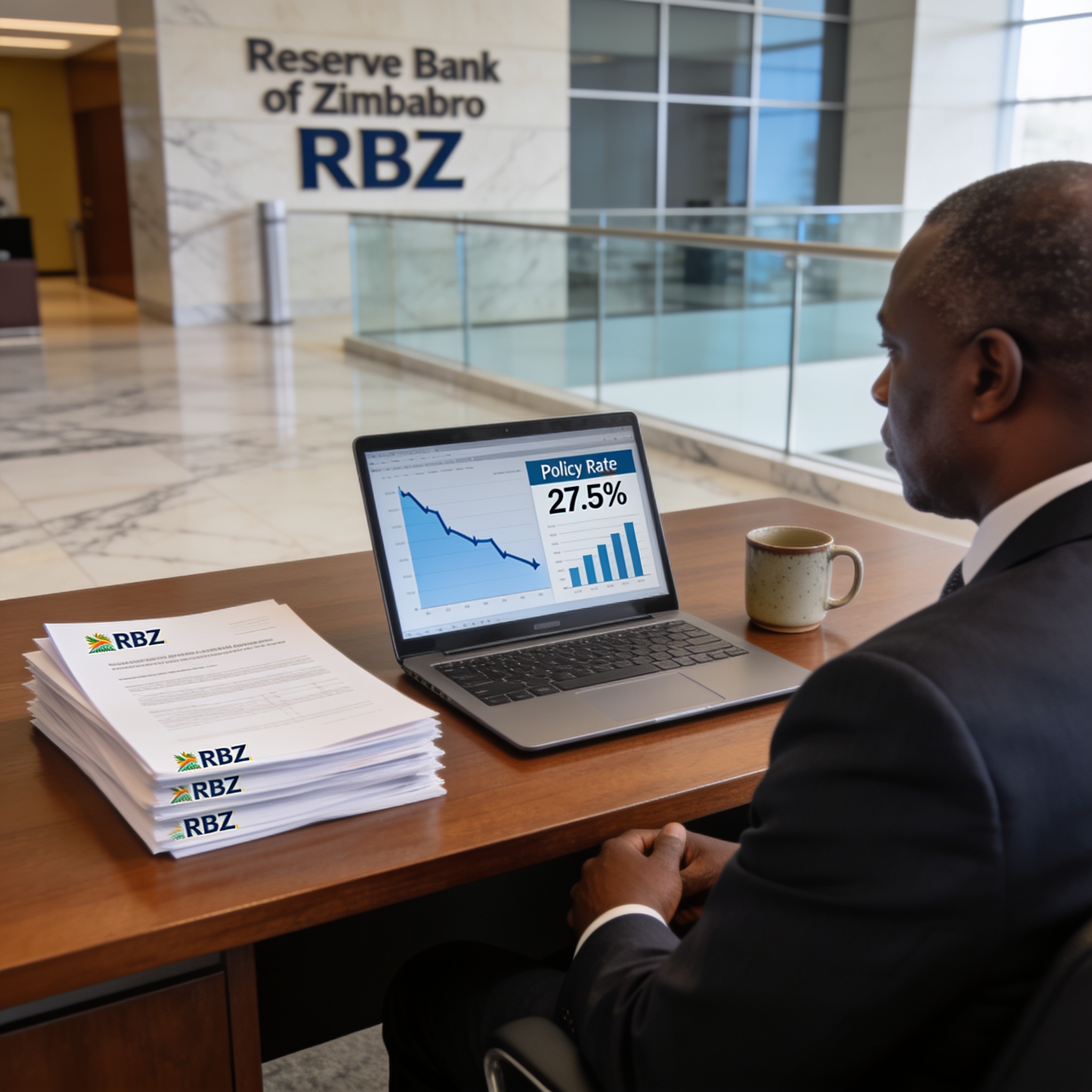
The Reserve Bank of Zimbabwe lowered its benchmark policy rate to 27.5 percent from 30 percent on Tuesday, signalling a measured step toward cheaper borrowing as price pressures ease and export receipts remain firm. The move, decided by the Monetary Policy Committee at its Monday meeting, is the second reduction this year but comes with an explicit warning that policy remains cautious rather than expansionary.
Why the cut was made
Governor John Mushayavanhu said the committee believed it could adjust the rate after several months of relatively contained domestic prices and a stable local currency against the US dollar. Annual ZiG inflation stood at 2.9 percent in August and rose slightly to 3.7 percent in September, mainly because of higher global oil prices. Month-on-month inflation has remained moderate, supporting the expectation that annual inflation will stay in single digits through the end of 2026.
External accounts have also improved. Foreign currency inflows reached US$14.3 billion in the eight months to August, up from US$10.3 billion in the corresponding period last year. Gold, mining exports and diaspora remittances led the gain, while the current account surplus strengthened in the first half of the year. Foreign currency reserves backing ZiG were reported above US$2 billion, giving roughly two months of import cover.
Separate national statistics data showed a wider monthly trade surplus in August, with exports at US$1.68 billion and imports at US$1.152 billion, leaving a surplus of US$526.5 million. Semi-manufactured gold dominated export value, while mineral fuels were the biggest import category. The combination of trade and balance-of-payments gains is what gives the central bank more room to adjust rates.
What businesses should read into it
For firms in Harare, Bulawayo and Masvingo, the lower benchmark may open a narrow path to reduced loan pricing. The central bank also trimmed the interest rate on the Targeted Finance Facility to 12.5 percent and capped commercial banks on-lending to productive sectors at 22.5 percent. Those measures are designed to steer credit toward investment rather than speculative demand.
Yet 27.5 percent remains a high cost of financing in a market where exchange-rate uncertainty, global interest-rate moves and weather risks still shape business confidence. The policy decision should therefore be read as a recalibration tied to observed inflation, not as a broad reopening of monetary stimulus.
Remaining risks
The committee highlighted heightened geopolitical tensions, oil-price volatility and the possibility of El Nino conditions during the 2026 and 2027 farming season as key sources of risk. Reserve requirements for demand deposits were left unchanged at 30 percent, while savings and time deposit requirements remained at 15 percent, and minimum deposit rates were kept at current levels. The bank will continue issuing ZiG-denominated term deposit instruments to deepen local-currency savings and build a fuller yield curve.
The next test will be whether the easing cycle can extend without weakening inflation expectations or the exchange-rate band that has supported stability so far.