
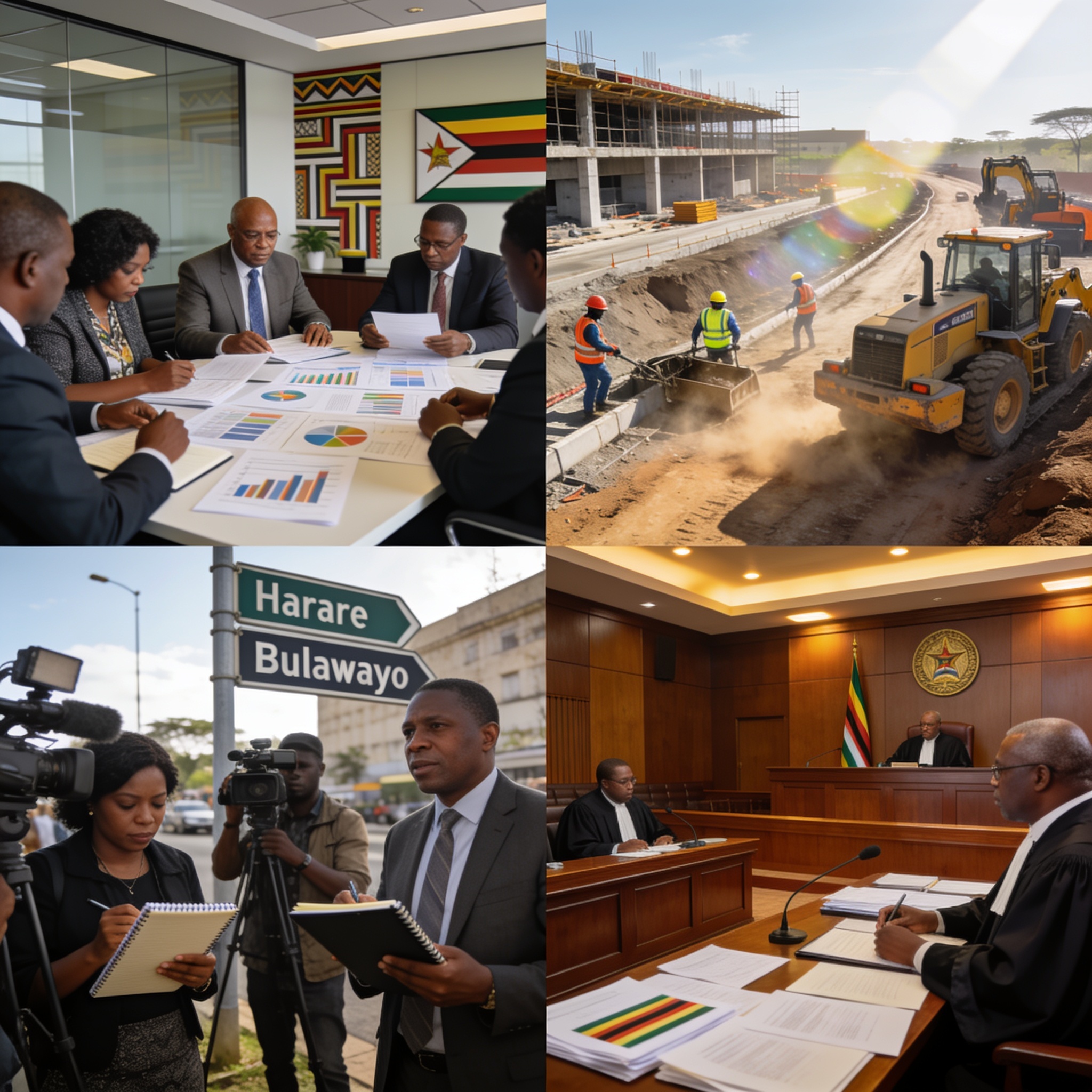
Zimbabwe Briefing: Budget Consultations, Infrastructure Push, Media Pressure and Court Cases
Harare begins the working week with an unusually broad menu of stories, stretching from budget diplomacy and infrastructure finance to media sustainability, public safety and contentious court hearings. Together, they show a country trying to revive growth while managing governance frictions that remain in plain view.
2027 Budget and the Search for Public Consent
Parliament has started taking the 2027 national budget consultation process directly to citizens, a move that signals both the need for wider input and the pressure on policymakers to justify revenue choices, spending priorities and service delivery promises. The exercise comes as state bodies and industry groups push the idea of mobilising big private flows into rail, energy and urban infrastructure to bring down logistics costs and restore competitiveness.
The broader policy mood is one of repair. Road upgrades between Harare, Masvingo and Beitbridge are reported to be moving forward, border-post modernisation finance is being assembled around Chirundu, and state institutions are being asked to plan agricultural credit and informal-sector formalisation with more discipline. In Harare, the practical question is whether these projects create visible jobs, not merely impressive balance-sheet entries.
Business Signals: Resilience, Splits and Credit Squeeze
Corporate news offered mixed but telling indicators. Infrastructure-linked businesses reported promising maiden results and a growing interest in tower, power and real estate assets, while a property developer linked major smart-city ambitions to housing demand on the urban fringe. A diversified mining group also reported a strong turnaround after exiting a diamond associate.
But not every recovery is simple. A producer of rubber and chemicals described financial constraints after suppliers tightened credit following a sovereign risk downgrade, while banks told farmers that formal financial planning is becoming a prerequisite for borrowing. Dinson’s Manhize-linked demand for rail services, meanwhile, underlines how anchor industrial projects can become both customers and arguments for state railway revival.
Regional Media Pressure and Zimbabwe’s Information Landscape
For Harare readers, the warning that Southern Africa’s media space is under strain is not abstract. A regional media freedom advocate said shrinking donor funding, weaker democratic protections and the costly transition to digital platforms have created an existential moment for independent journalism and access to information. The point has local resonance: newsrooms that depend on sustainability, public trust and legal clarity are now being tested simultaneously.
The issue was sharpened by a high-profile labour and reputation dispute filed in the High Court, in which a media group has sued staff members over allegations tied to workplace grievances. Whether or not the case ultimately succeeds, it reflects a broader challenge: how employers and workers navigate public accusations, social media and court remedies in a compressed media economy.
Courts, Church and Civic Authority
Zimbabwe’s civic calendar is also crowded with matters of justice and memory. The High Court has been involved in disputes over mining claims, criminal sentencing and alleged financial diversion, while Masvingo gained attention after a fatal fire involving a divorce case due at the station. In another province, a council member is facing serious criminal allegations, reinforcing public anxiety about accountability for local officials.
The Zimbabwe Catholic Bishops’ Conference offered a regional statement of solidarity with an arrested Zambian archbishop, calling for due process and truth amid post-election tensions in Zambia. It was a reminder that church voices in Zimbabwe often speak across borders, especially where political stress, religious authority and judicial process intersect.
Nearby, Chivi saw a delayed memorial unveiled for Reverend Ezra Shumba, described as the first black minister of what is now the Reformed Church in Zimbabwe. The ceremony, ending decades of unfinished recognition, showed how institutional memory is not always settled in ledgers but in graves, congregations and the patience of families.
Politics, Veterans and Electoral Geography
On the political front, President Mnangagwa is expected to engage more than 10,000 children of liberation war veterans in Harare, a gathering that combines symbolic legitimacy, social outreach and the perennial question of what the state owes the families of the struggle.
At the local level, Zanu-PF captured Ward 18 in Hwange Rural District Council from the Citizens Coalition for Change, a result likely to be read as a sign of shifting ward dynamics even amid national disputes over governance and economic delivery. In Masvingo, a new High Court judge’s arrival is being treated as an attempt to ease caseload bottlenecks, another sign that political attention and administrative reform must eventually meet in courtrooms.
Sports and Infrastructure Ambitions
Cricket has become another lens through which Zimbabwe’s capacity is tested. An International Cricket Council team has started venue inspections ahead of the 2027 World Cup, while England are reported to be set to return to Harare for group-stage action after more than two decades. For a host nation, the task is not only to stage matches but to prove that logistics, security, hospitality and media operations can deliver a credible international event.
Young Warriors unity ahead of an Under-23 Afcon qualifier, meanwhile, offers a lighter note, but one still tied to Zimbabwe’s wider need for platforms where national institutions can show competence under public scrutiny.
Public Safety Enters the Week
Rainy-season warnings from Bulawayo’s fire service should not be read as routine noise. The council’s chief fire officer urged residents to check electrical appliances, avoid overloaded sockets, keep generators outdoors and reject makeshift connections after risks of fire, shocks and carbon monoxide poisoning. The advice has national relevance in an environment where power instability and informal repairs remain common.
Elsewhere, a woman was reported to have died in a house fire in Iminyela, while police in Beitbridge announced the arrest of six suspects linked to a wave of armed robberies that terrorised the border town. The cases show that economic pressures and public order remain connected: a country chasing investment cannot afford to lose its grip on neighbourhood safety.
The Harare Express Take
The Monday briefing reads like a map of Zimbabwe’s next test: can growth be financed, governed and communicated in a way that produces trust as well as concrete projects? The state is moving through budget consultations, infrastructure finance and veteran outreach. Private capital is being courted in rail, energy, towers and urban housing. Yet courts, workplace disputes, church-solidarity gestures, public-safety warnings and unresolved incidents all suggest that legitimacy will not be restored by balance sheets alone.
For readers in Harare, the week’s story is therefore not simply which policy is launched or which court case advances, but whether institutions can connect promises to delivery without letting pressure points turn into crises.