
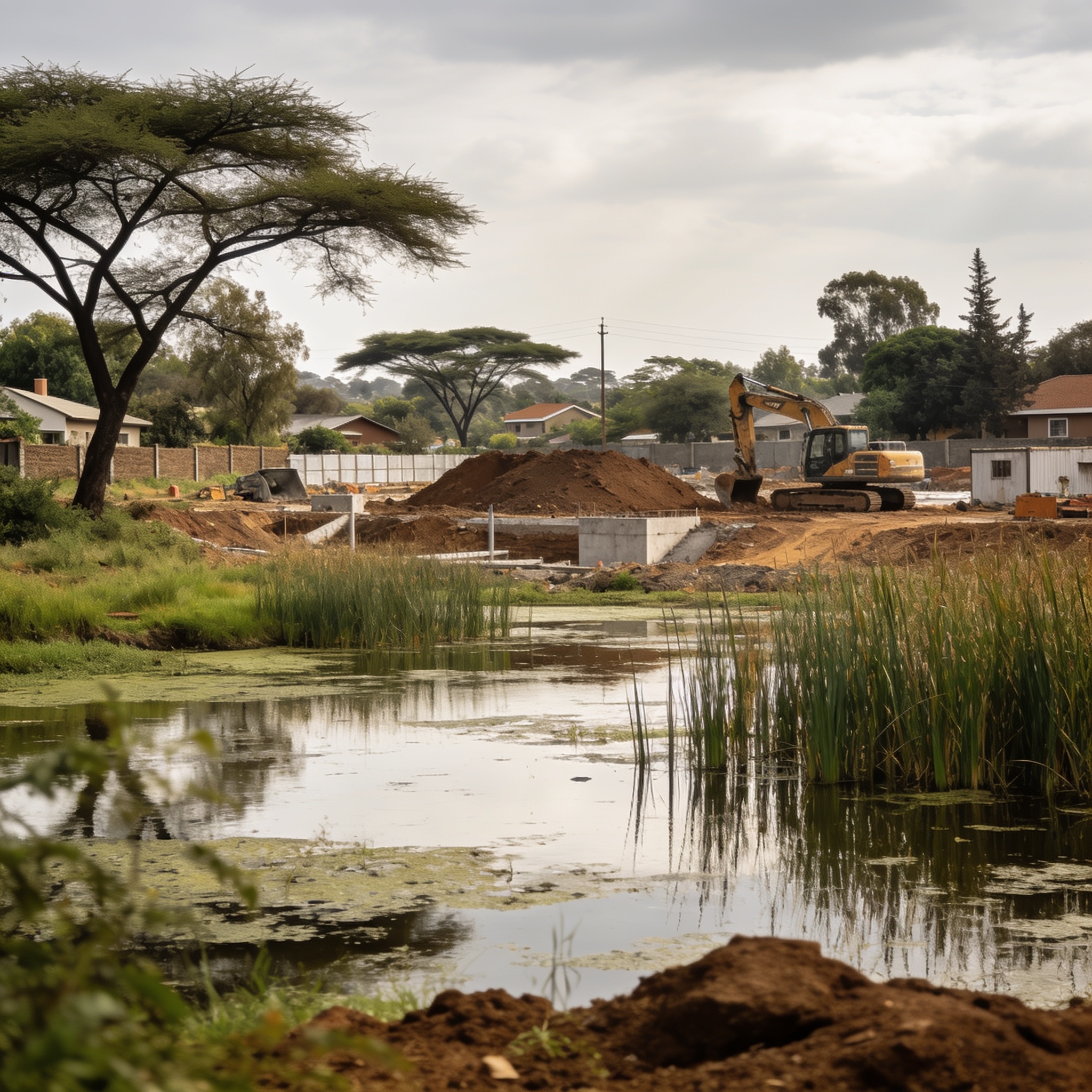
The High Court in Harare has issued an interim order halting construction by Chinese-owned developer Zhuomu International (Private) Limited on a legally protected wetland in the upmarket suburb of Glen Lorne, following an urgent application by businessman Shingai Mutasa and 26 other residents.
The order, granted by consent before Justice Samuel Deme on Monday, temporarily stops all work at Stand 4717 while the broader legal dispute is resolved. The residents had approached the court after alleging that construction of a perimeter wall had already encroached into an area excluded from development under the company’s environmental approval.
Development details and allegations
Zhuomu’s planned project comprises 21 standalone villas and 75 cluster housing units across approximately 9.2 hectares. According to Mutasa’s founding affidavit, residents observed grading and levelling near the Umwinsi River on 5, 17 and 18 August, followed by trenching and wall construction. On 24 August, a JCB excavator digging a trench for the perimeter wall along Lytham Road reportedly moved down the slope into what appeared to be the restricted area. The next day, residents say the machine trenched across a minor stream feeding a dam on a neighbouring property.
The residents further allege that rubble, soil and felled trees were dumped within the restricted zone, and that boreholes were being used before it could be confirmed whether the necessary water abstraction permits were in place. They say they reported the activities to the Environmental Management Agency (EMA) and water authorities, and that while EMA officials did inspect the site, the alleged violations continued.
Residents also say they were left without clarity on whether the City of Harare’s approval of the boundary wall could override environmental restrictions imposed under the developer’s Environmental Impact Assessment (EIA) certificate. According to the affidavit, the bulk of the property was gazetted as part of the Helensvale Ecologically Sensitive Area in 2022.
Mutasa says the Environmental Management Act prohibits certain activities on protected wetlands without written authorisation, while environmental regulations also restrict drilling, soil alteration and the disturbance of natural vegetation in wetlands and areas close to public streams.
Legal strategy and environmental concerns
The applicants are not asking the court, at this urgent stage, to make a final determination on the legality of the EIA certificate or other approvals. Instead, they are seeking to preserve the status quo while they obtain the necessary documents from the authorities and prepare a full legal challenge. Their case also invokes the constitutional right to an environment that is not harmful to health or wellbeing, along with rights relating to food, water, administrative justice and access to information.
A central concern raised in the case is the potential impact on Harare’s wider water systems. Mutasa says the property forms part of the Umwinsi headwater wetland ecosystem, which drains into the Nyagui River and ultimately the Mazowe River. He cites an assessment by wetlands expert Dr Rob Cunliffe, warning that the proposed development could have serious consequences for both local and downstream water supplies. The assessment warns that replacing natural surfaces with roofs, roads and paving would reduce infiltration and groundwater recharge, while increasing runoff and the risk of downstream flooding. It also raises concerns over pollution, siltation, and the cumulative impact of drilling multiple boreholes within the wetland ecosystem.
The residents’ lawyer, Lincoln Majogo of Mtetwa & Nyambirai Legal Practitioners, said the consent order gave his clients the immediate protection they had sought. He added that the parties would return to court in line with agreed timelines, while also continuing to explore a possible out-of-court settlement.
The case highlights growing tensions between urban development and environmental protection in Harare, where wetlands are increasingly under pressure from housing and commercial projects. It remains to be seen whether the parties can reach a settlement or if the matter will proceed to a full hearing on the legality of the development’s approvals.