
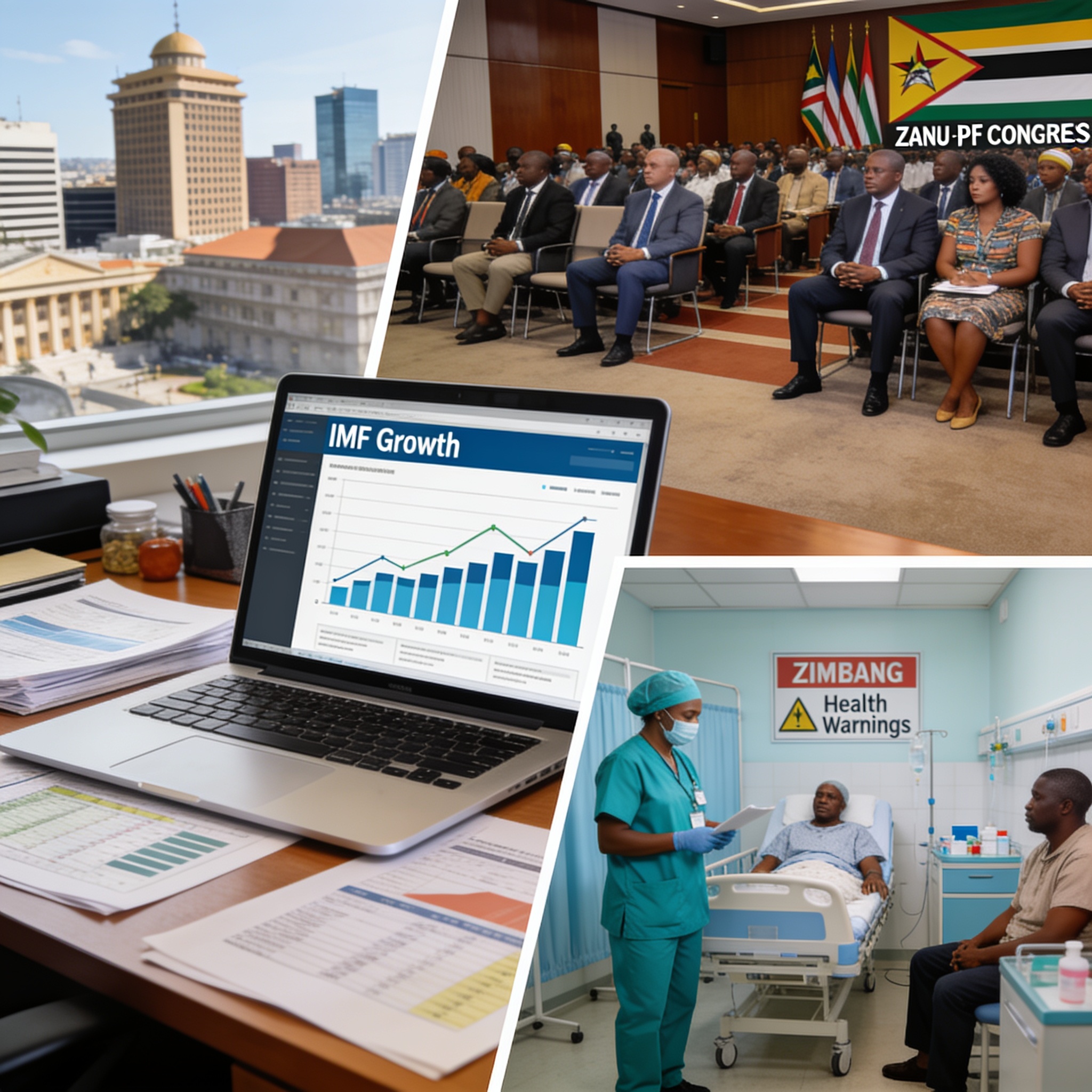
Harare’s Tuesday reading list is anchored by an unusual mix of optimism and warning. A fresh International Monetary Fund assessment says Zimbabwe’s stabilisation programme is producing visible gains, while the political calendar in Mashonaland West, a widening health-funding cliff and several local court and governance actions suggest the cost of living and service delivery remain central to readers’ concerns.
IMF points to 5% growth, but risks stay close to home
The IMF’s second review of Zimbabwe’s 10-month staff-monitored programme marks a notable endorsement. It projects real growth at 5 percent for 2026 and says annual ZiG inflation has eased to 3.7 percent, with the exchange rate holding steady and the current account expected to remain positive. Revenue collections have surpassed plan, giving fiscal authorities some room for social spending, priority projects and buffer-building. Yet the Fund also expects growth to slow in 2027 because of weather-related pressures, a reminder that Zimbabwe’s recovery remains linked to agriculture, energy and climate resilience.
For Harare, the macro numbers matter most when they reach household reality: supermarket prices, electricity reliability, job creation and public-health access. The IMF review strengthens confidence in reform discipline, but Harare Express readers will watch the 2027 budget for evidence that growth is translated into clinics, schools and livelihoods.
Zanu-PF congress in Chinhoyi shapes the political tone
As Zanu-PF delegates deliberate in Chinhoyi, Mashonaland West, the conference is being read not only as internal party business but as a measure of the country’s political atmosphere. The discussion around COMESA summit preparations underscores the tension between domestic mobilisation and external image: government wants regional engagement and economic diplomacy, but the public is asking whether the same order, messaging and resources can deliver services at home.
For Harare readers, the political signal is practical. A well-organised regional summit should not sit beside crumbling car parks, long clinic queues and inconsistent local enforcement. The party gathering and the COMESA calendar are therefore part of the same accountability story.
Health spending cliff looms as donor funding retreats
Perhaps the most sobering line on today’s agenda is the warning that the end of major US bilateral health support is creating a difficult budget gap. Reports describe pressure on malaria treatment, insecticide-treated nets, laboratory systems, community health workers and HIV service continuity. In some areas, patients say stock shortages and delayed services are already causing danger.
Zimbabwe built strong gains against HIV and malaria with partner support, including PEPFAR. The absence of a new agreement, alongside projected shortfalls, forces urgent choices: emergency donor mobilisation, more transparent domestic financing, sharper procurement and clearer public communication. The government has set a national health strategy and pledged higher domestic allocation, but Harare’s clinics will measure those promises by medicine availability and safe maternal care.
Harare court ruling shows how thin evidence can sink a claim
The High Court’s decision against the family of Francis Nyadundu in a US$520,000 negligence claim against Avenues Clinic is legally instructive. The court accepted that a duty of care existed but held that the family had not produced medical expert evidence showing breach or causation. Nursing notes recording risks and precautions were not enough, on their own, to prove that staff conduct caused the death or that earlier treatment would have prevented it.
The ruling is harsh for a grieving family, and the costs order will sting. It also reinforces a recurring point in Zimbabwean public discourse: accountability is needed, but proof standards and regulatory transparency must be clear enough to protect both patients and institutions.
Chitungwiza’s abandoned vehicle cleanup is a broader urban test
Chitungwiza Municipality has given guarded car-park operators and owners seven days to remove abandoned vehicles and scrap shells before enforcement begins. The action is framed as a cleanliness, safety and crime-prevention measure, and it addresses a familiar problem in high-density areas: neglected vehicles become informal dump sites, drug dens and obstacles to orderly mobility.
But the notice also repeats a pattern: a previous similar order did not produce lasting order. Unless enforcement continues after the deadline and illegal car parks are properly regulated, the cleanup may become another cycle of announcements rather than permanent improvement. For a township seeking public space that is safe, clean and usable, that distinction is crucial.
Sport, arts and international connections shape today’s mood
Zimbabwean sport is also in the headlines, with loss and continuity intertwined. Former fast bowler and international umpire Sarah Dambanevana died in Harare at 36. She helped put Zimbabwean women’s cricket on a global stage, including officiating in World Cup tournaments and becoming the first Zimbabwean woman to umpire a World Cup final. Her passing is a reminder that sport’s institutional memory is also built through women who move quietly behind the camera and boundary line.
Domestically, Castle Premier Soccer League news has a local angle: Hardrock’s debut-season momentum is gaining commercial traction through a partnership with a gaming company, while Scottland are shifting focus after continental action and preparing to face Petro de Luanda. ZIFA board member Brighton Ushendibaba praised President Nqobile Magwizi for negotiating with CAF to support the national team, and Hwange remain top of the ZIFA Southern Region standings.
Elsewhere, Tino Kadewere opened his season’s account for Aris Thessaloniki in Greece, a useful result for the national team’s forward options, while Simbarashe Steyn Kundizeza is under a Caine Prize inquiry over allegations involving artificial intelligence in his award-winning short story, The Blue Fighter. The arts debate matters because reputation, authorship and publishing ethics are now global and digital.
Zimbabwean diaspora, regional politics and criminal cases
Several stories link Harare’s newsroom to events outside Zimbabwe. Chris Nyamandi, the South Sudan country director for Save the Children, was reportedly detained in Juba amid a tighter political environment ahead of elections; the case highlights risks faced by humanitarian staff when political discussion is restricted. South Africa’s deputy police chief resigned while facing sexual-offence charges and organised-crime links, a development with relevance for regional law-enforcement credibility. In Scotland, the accused in the racially aggravated murder of Dr Fortune Gomo, a scientist originally from Mutare, denies the charge, with trial set for 2028.
There are smaller Zimbabwean successes too. Riley Mamvura will perform in Lichfield later this month as part of the Momentum programme, showing how music and mobility continue to export the country’s creative talent. In Bulawayo, a man was jailed for two years over dagga worth ZiG40,380, while a Kwekwe councillor appeared in court over an alleged sexual offence involving a minor; both remind readers that enforcement cases are local and national.
Taken together, today’s digest points to a country with macroeconomic momentum, political mobilisation and reputational stakes, but also with health-system fragility, urban governance gaps and legal accountability tests. Harare’s most important question remains simple: will these signals improve daily life before the next news cycle replaces them?