
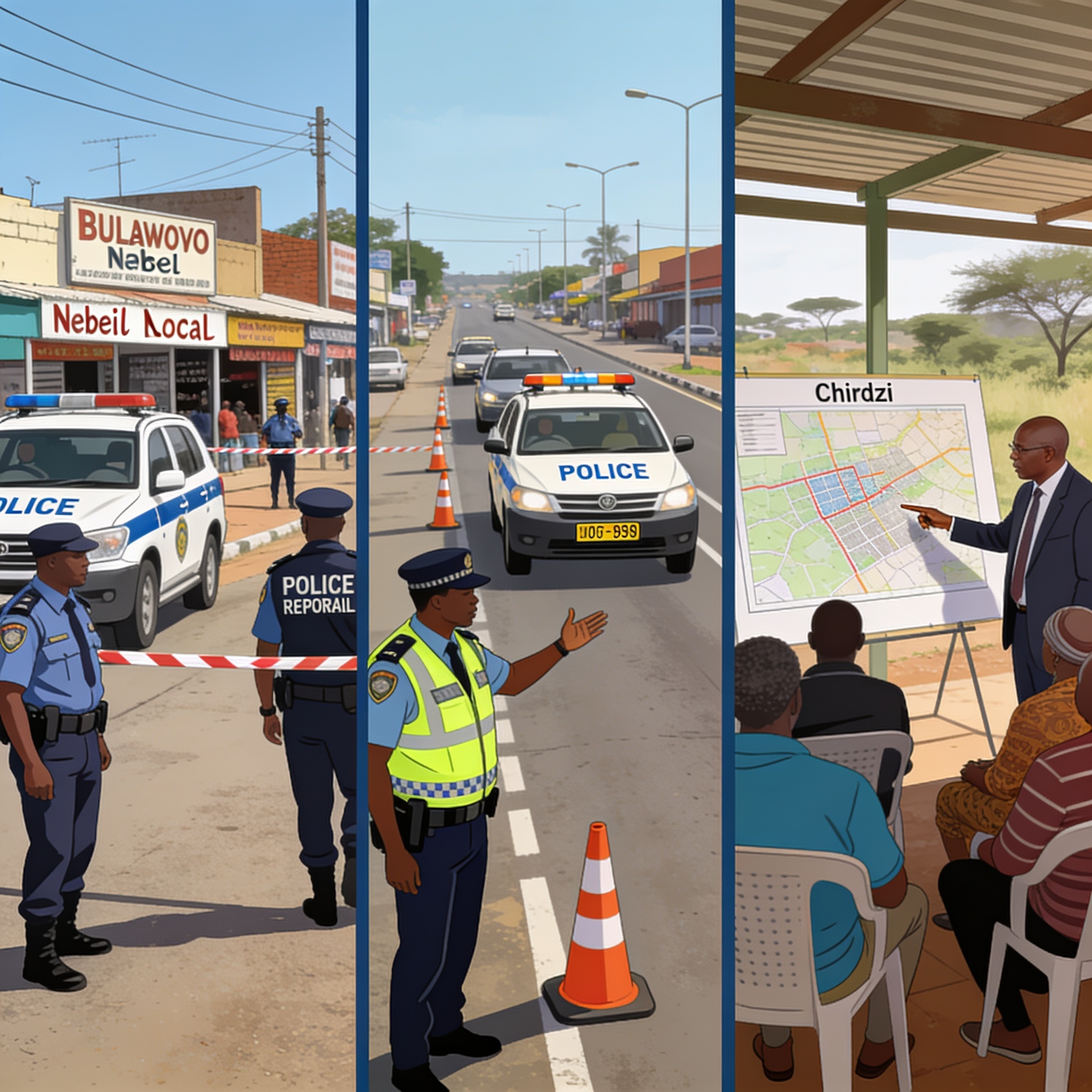
Harare Express – Zimbabwe’s news cycle on Wednesday 21 October 2026 was defined by security operations in Bulawayo, renewed concern over highway fatalities and a local authority bid to unlock land for urban growth in Chiredzi.
For readers following governance, commerce and daily life in the capital, the day’s stories showed how tightly linked those pressures are: crime response, road safety, housing demand, energy costs and regional diplomacy all affect the same household and business budgets.
Police say suspects in Bulawayo robberies were tracked down after armed confrontation
The Zimbabwe Republic Police said two suspects were detained after officers confronted a group linked to violent robberies in Umguza. One suspect was fatally shot during the operation, police said, while the other two remain in custody.
Police statements describe a sequence that began with attacks on homes, allegedly involving machetes and other weapons, theft of cash and valuables, and the later use of police tracking capabilities to locate the men near Norwood. Officers reportedly fired warning shots before opening fire when the suspects allegedly advanced toward them.
The death will almost certainly attract questions about use of force and suspect handling, particularly as communities in urban and peri-urban areas worry about repeat robberies. The episode also comes as the police are reported to be acquiring tactical rifles and beginning command-level training, reflecting authorities’ emphasis on a stronger operational response to crime.
Another fatal crash reopens the debate on the Harare-Bulawayo corridor
Separately, attention shifted back to road safety after a fatal collision near Kadoma killed three people along the Harare-Bulawayo road.
The route is Zimbabwe’s main economic spine, linking Bulawayo, Harare, Mutare and the corridor’s industrial towns. The crash revives worries that remain despite major infrastructure spending on the corridor, including ZINARA’s recent announcement that it has settled a large loan used to reconstruct it.
Drivers and freight operators argue that road safety is not only about pavement. It depends on enforcement against speeding, improved signage near towns, vehicle maintenance checks, and quicker emergency response. For families travelling between major cities, another death on the route makes those gaps painfully real.
Chiredzi seeks room to grow as land becomes scarce
Some of the most consequential planning news is now emerging from smaller cities. In Chiredzi, local officials say a long-pending masterplan could deliver 6,000 hectares of fresh land for residential and commercial expansion if national approval comes through.
The town has reportedly exhausted developable space inside its existing boundaries, leaving thousands of applicants waiting for housing or business plots. The proposed expansion in Buffalo Range could ease a land shortage that has shaped urban growth in many Zimbabwean towns.
But approval alone will not solve the problem. Access to serviced stands, utility networks, transport links and affordable construction materials will determine whether the new land becomes useful housing or another stalled plot bank.
Building rules aim to reshape the CBD
Chiredzi is also moving toward stricter commercial building standards, including a requirement that new CBD structures be at least two-storey and incorporate more glass frontages. The stated goal is to raise the quality of the built environment, improve density and modernise an area dominated by aging low-rise stock.
The policy raises a broader question for Zimbabwe: can smaller towns use design rules to look more modern without raising costs beyond local businesses’ reach? If implemented carefully, such measures can encourage better maintenance and higher investment. If done rigidly, they could simply slow redevelopment.
Regional diplomacy, agriculture and energy remain in the frame
Harare is preparing to host a COMESA summit, bringing regional leaders together at a time when trade coordination and investment diplomacy matter more than usual. For Zimbabwe, the meeting is another chance to push for smoother cross-border commerce and better access to regional financial instruments.
Those themes were reinforced by Afreximbank’s push for private sector use of a large agricultural financing facility aimed at production and processing. With climate shocks and high input costs squeezing farmers, capital that supports local value addition rather than raw exports is worth watching.
That idea also echoes Professor Gift Mugano’s critique that exporting raw animal products rather than finished goods locks in losses for African producers. For Zimbabwean manufacturers, the message is familiar: beneficiation is not a slogan but a necessary shift if economies want jobs, foreign currency and stronger supply chains.
The energy outlook remains difficult. The International Energy Agency has warned that global oil markets may not stabilise quickly, with Middle East disruptions and refinery constraints keeping pressure on petroleum products. Brent crude has been trading high, and that environment feeds directly into Zimbabwe’s fuel import bill, transport costs, food distribution expenses and household budgets.
Businesses will need to review logistics contracts and cash-flow assumptions. Households, meanwhile, are likely to feel any pass-through in prices before they feel any long-term relief.
Courts and policy shape the wider economic story
Legal and regulatory developments continued to attract business attention. A court application seeking to block RioZim’s proposed Renco transaction underscored how corporate restructuring, shareholder rights and asset sales can become contested in real time. At the same time, government officials signalled renewed attention to reserved sector enforcement for foreign-owned businesses, another reminder that policy implementation remains part of the investment climate.
Civil courts also remained busy. In one High Court matter, a woman’s bid to be declared the sole surviving spouse of a late husband who left multiple properties was dismissed. The case may have been personal, but its implications are practical: estate disputes, multiple property claims and family arrangements can delay transfer, create uncertainty and consume legal resources.
Public life beyond the headlines
The national conversation also included stories that shape community health and information capacity. The death of a cancer-stricken teenager who had drawn public attention by sharing a letter has renewed discussion about paediatric oncology support, emotional care and the dignity owed to families in grief.
Meanwhile, the Environmental Management Agency is equipping journalists with better reporting tools on environmental issues. In a country where mining, deforestation, wetland pressure and climate vulnerability are central to development, informed media coverage matters.
Together, the day’s reports point to a familiar Zimbabwean tension: progress in some corridors and constraints in others. Infrastructure can be rebuilt, land can be planned, courts can rule, and diplomats can meet. Yet households and businesses still need safety, affordability and predictability.
Why this matters for Harare
Harare readers should care about all of these stories because they converge in ordinary decisions: whether to take a night bus, where to build a home, whether to expand a business, how much diesel will cost, and whether public institutions can enforce rules without becoming erratic.
The practical test now is follow-through. Safer roads require enforcement and maintenance. New urban land requires services, not just paperwork. Anti-crime operations require accountability alongside efficiency. Energy and trade pressures require transparent planning and credible support for producers.
For Harare Express, the measure of the day is not the number of headlines, but whether the stories reveal the gaps Zimbabwe must close to make daily life more secure and more economically manageable.