
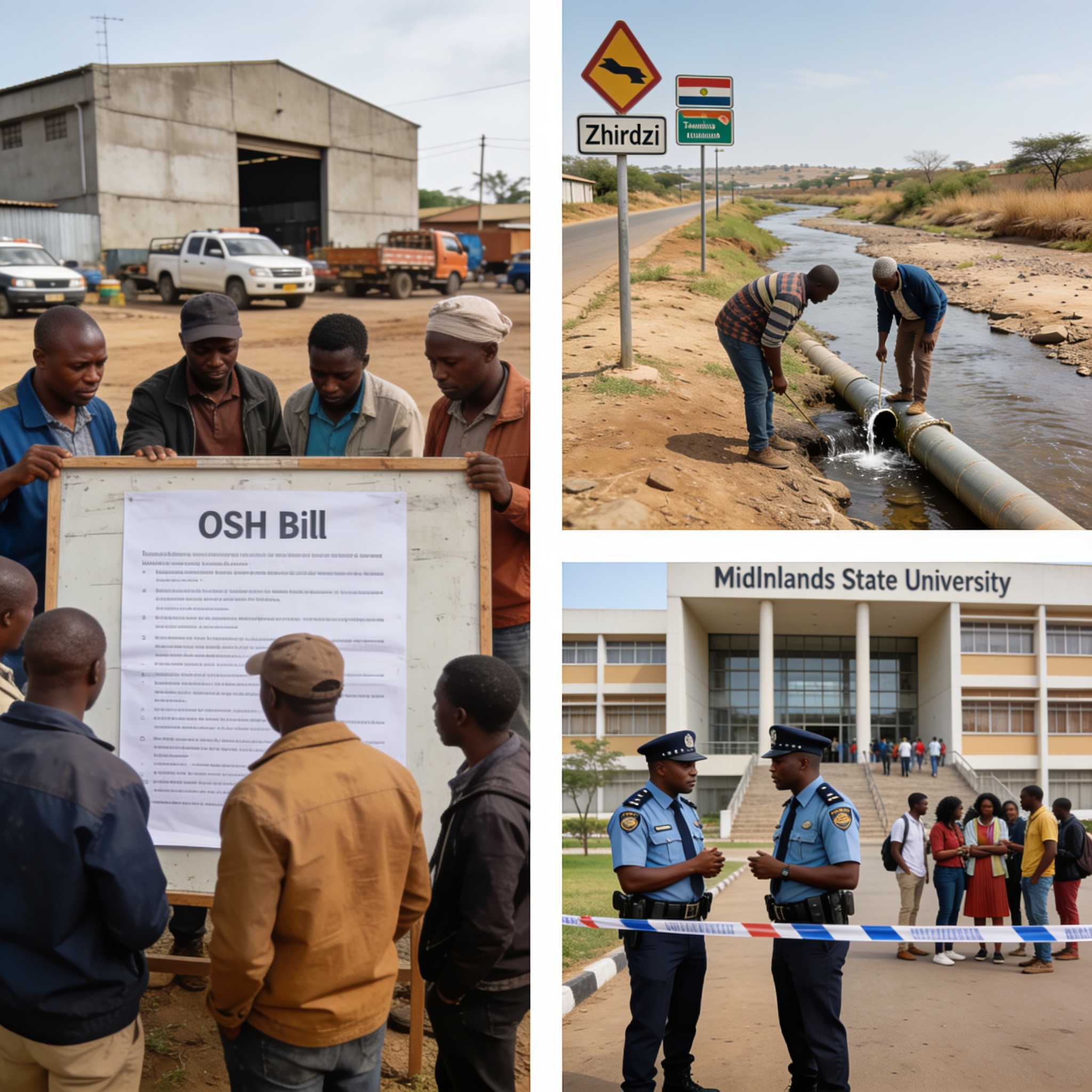
Zimbabwe’s Friday morning news cycle on October 9, 2026 brought together several stories that matter to Harare readers: workplace protections, rural water access, campus violence allegations, funeral coverage controversy, and the country’s continuing appetite for food culture and motor sport. Taken as a single snapshot, the day showed how service delivery, public order and media freedom can all arrive at once.
NSSA backs OSH Bill as landmark for safety
NSSA General Manager Charles Shava has welcomed the Occupational Safety and Health Bill, calling it an important step for workers and employers. The proposal is being read as a move to bring Zimbabwe’s workplace rules closer to modern standards: clearer duties on employers, better reporting of hazardous conditions, and stronger protection for informal and contract workers who often fall outside formal safety systems. For Harare, the question is implementation. A law can set expectations, but enforcement must reach factories, clinics, transport yards and municipal services.
Chiredzi families leave contaminated spring after 26 years
In Chiredzi North, residents of Feversham resettlement area said they finally have a clean water point after more than two decades. A solar-powered borehole, installed by Leonard Cheshire Disability Zimbabwe in partnership with government, replaced a natural spring that villagers used alongside baboons and other wildlife. Councillors and village leaders said the old source exposed families to disease risk because animal waste contaminated the water.
The project also includes a nutrition garden aimed at supporting vulnerable women and people living with disabilities. Its relevance is not only local. Reports from the Chiredzi Rural District Council have highlighted ongoing water shortages, showing that rural infrastructure remains one of the country’s biggest governance challenges. Harare Express readers in high-density neighborhoods and resettlement areas will recognise the same pressure: water is not just a utility issue, it is health, dignity and livelihood.
MSU campus tragedy and allegations of targeted shooting
A Midlands State University student is reported to have died in an alleged point-blank shooting connected to a former partner. If confirmed by police and court proceedings, the case would again expose the risk that domestic disputes can turn fatal when weapons are accessible. It also raises a duty of care question for universities: how quickly campus security, counselling services and community protection networks respond when a student becomes the target of an ex-partner.
Funeral coverage assault claim deepens debate on reporter safety
TechMagTV editor Toneo Toneo has alleged that he was attacked by three men while covering the funeral of Wicknell Chivayo and has made a police report. Funeral scenes often mix grief, crowds, security details and media attention; they can become flashpoints when journalists are perceived as intruders. The allegation deserves careful handling until police investigate, but it adds to a recurring concern for Harare readers: reporters covering sensitive political, social or celebrity events must be allowed to work without violence.
The controversy is also coloured by messages posted before Chivayo’s death, in which he sought prayers and protection from people around the world. Those final online appeals have sparked reflection rather than speculation, and Harare Express treats them as part of the public record, not as proof of any hidden threat.
Entertainment and lifestyle stories keep Zimbabwe’s calendar moving
Amid the harder news, Bulawayo’s food scene is in focus with nominees announced for the second Bulawayo Eats Awards. The awards matter for local tourism, restaurant confidence and young culinary entrepreneurs, especially when entertainment and hospitality are trying to recover from economic strain.
Gweru, meanwhile, is preparing for a weekend burnout event. Motor culture can energise small businesses and car enthusiasts, but it should be managed around traffic safety, noise control and police cooperation. Harare’s own nightlife and motor events face the same balancing act: celebration without public risk.
High-profile damages claim tests boundaries of public reputation
Journalist Musorowegomo Mukosi has issued a legal demand for US$200,000 in damages against Grant Thornton Zimbabwe partner Kundai Francis Tibugare, alleging that the affair damaged his marriage. The letter, through lawyer Admire Rubaya, refers to travel records, call data and alleged hotel use as evidence. As with any unproven civil claim, Harare Express separates allegation from proof: courts, not headlines, should determine the facts.
What the day means for Harare
Read together, these stories point to three urgent themes for urban Zimbabwe. First, safety laws must become practical protections at workplaces and campuses. Second, basic services such as water need to move from pilot projects to sustained public infrastructure. Third, public events and media coverage require clear rules so grief, protest, celebration and journalism do not collapse into confrontation.
For Harare Express, the value of a news roundup is not simply to list what happened, but to connect each item to the daily realities of readers: the commute, the clinic, the kitchen, the school gate and the phone notification that someone has been harmed.