
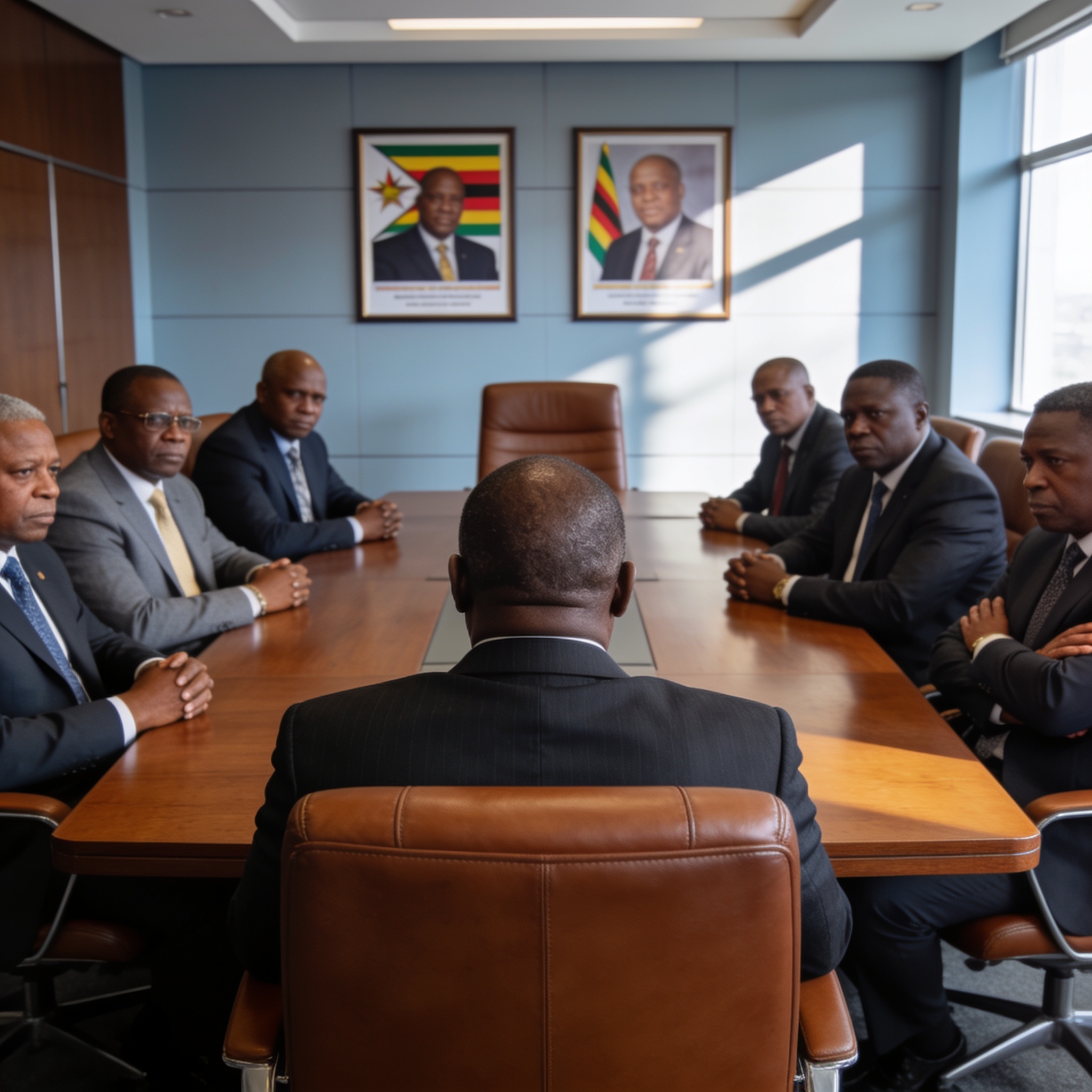
ZANU-PF Politburo Pause Deepens Harare Succession Tensions
HARARE — A last-minute pause in a ZANU-PF Politburo session has sharpened speculation inside the capital that the party’s ruling structure is being tested over presidential succession, constitutional control and elite patronage. Officials had been summoned to Harare for an extraordinary meeting on Friday, but it was postponed as attendees gathered, leaving even experienced party watchers searching for a credible reason.
ZANU-PF spokespeople offered a routine scheduling explanation, pointing to overloaded presidential programmes. For many observers that answer felt too small for the scene: senior figures travelling across the country, then being asked to stand down without a clear public account. The episode suggests that some decision-making inside ZANU-PF has become difficult to explain through ordinary administrative language.
The Mnangagwa-Chiwenga question moves into view
The political centre is President Emmerson Mnangagwa and Vice-President Constantino Chiwenga. At issue are proposed changes to party rules, alignment with a contested constitutional amendment and steps that could reshape succession. If the Politburo pause was meant to prevent a public collision, it has had the opposite effect: it has shown how brittle the elite settlement may be.
In Harare’s political circles, the meeting’s collapse is read less as a scheduling error and more as a symptom of a deeper argument: who controls the ZANU-PF rulebook, who benefits from appointments made under it, and whether the security establishment can remain united behind one leadership line. The postponement may have been a retreat, but retreats in ZANU-PF history can precede both accommodation and rupture.
Tagwirei’s cabinet appointment feeds constitutional unease
The dispute cannot be separated from the elevation of Kudakwashe Tagwirei to Cabinet as minister for economic development and investment promotion. Tagwirei entered Parliament through one of the Senate seats associated with the constitutional amendment, a route that critics say is legally unsettled while challenges are before courts. For them, pushing a beneficiary of a contested amendment into Cabinet creates pressure for political normalisation.
The Zimbabwe Constitutional Movement and other voices argue that appointments should not treat an unresolved constitutional dispute as closed. Their broader warning is institutional: once the executive fills high office under a disputed legal framework, those appointed may have an interest in defending that framework, weakening Parliament’s ability to question it. HarareExpress readers may see a familiar pattern: formal power moves faster than formal accountability.
Tagwirei’s business interests also sharpen the conflict-of-interest question. The minister holds portfolios touching investment, trade and public procurement, while his commercial footprint invites scrutiny. The government will need to explain how it will keep public decision-making separate from private advantage, especially when political appointments already carry an uncomfortable smell of patronage.
The opposition’s recall storm shows politics is not only ruling-party trouble
While ZANU-PF battles its own ghosts, the Citizens Coalition for Change has been forced to deny documents circulating in public that allegedly removed several of its elected representatives, including Bulawayo mayor David Coltart. The party says the letters have no legal or political value and describes the episode as extortion, coercion and destabilisation by persons seeking to undermine its reconstruction process.
That fight matters because Zimbabwe’s civic mood is already stretched. When citizens see ruling-party confusion and opposition instability at the same time, trust in public office can thin quickly. If recall mechanisms are used as rumour weapons, the result is not stronger democracy. It is a political economy of suspicion, where voters cannot tell which letter is official and which is a stunt.
A graduation ceremony, a security mandate and a crowded calendar
Against this tense backdrop, Mnangagwa also attended a large graduation for Zimbabwe Open University, where the institution emphasised open learning, skills for Vision 2030, and support for the constitutional amendment route. Such settings allow the ruling party to project continuity, competence and national prestige. Yet the Politburo pause and the Tagwirei row show that image is not enough to quiet elite disputes.
Zimbabwe also faces pressure on public finance, health programmes and worker protection, with international assessments keeping trafficking and labour exploitation on the agenda. These are not separate stories from party power politics. When elite competition consumes institutional bandwidth, ordinary service delivery tends to slow down, and Harare residents feel the result in clinics, schools, water points and job prospects.
What Harare should watch next
The immediate signal will be whether a postponed Politburo meeting is rescheduled, whether the party constitution process is paused, and whether ZICOMO or other groups can move their objections through courts or Parliament in a way that constrains further appointments. The other signal is security: if elite bargaining fails, pressure may move beyond party forums into the armed networks and state agencies that have shaped Zimbabwean politics for years.
For Harare, the lesson is less dramatic but urgent. A postponed meeting is not a small event when the country is watching a succession question, a constitutional amendment and cabinet patronage converge. Zimbabwe’s stability now depends on whether its political class can turn rivalry into rules, rather than rules into weapons.