
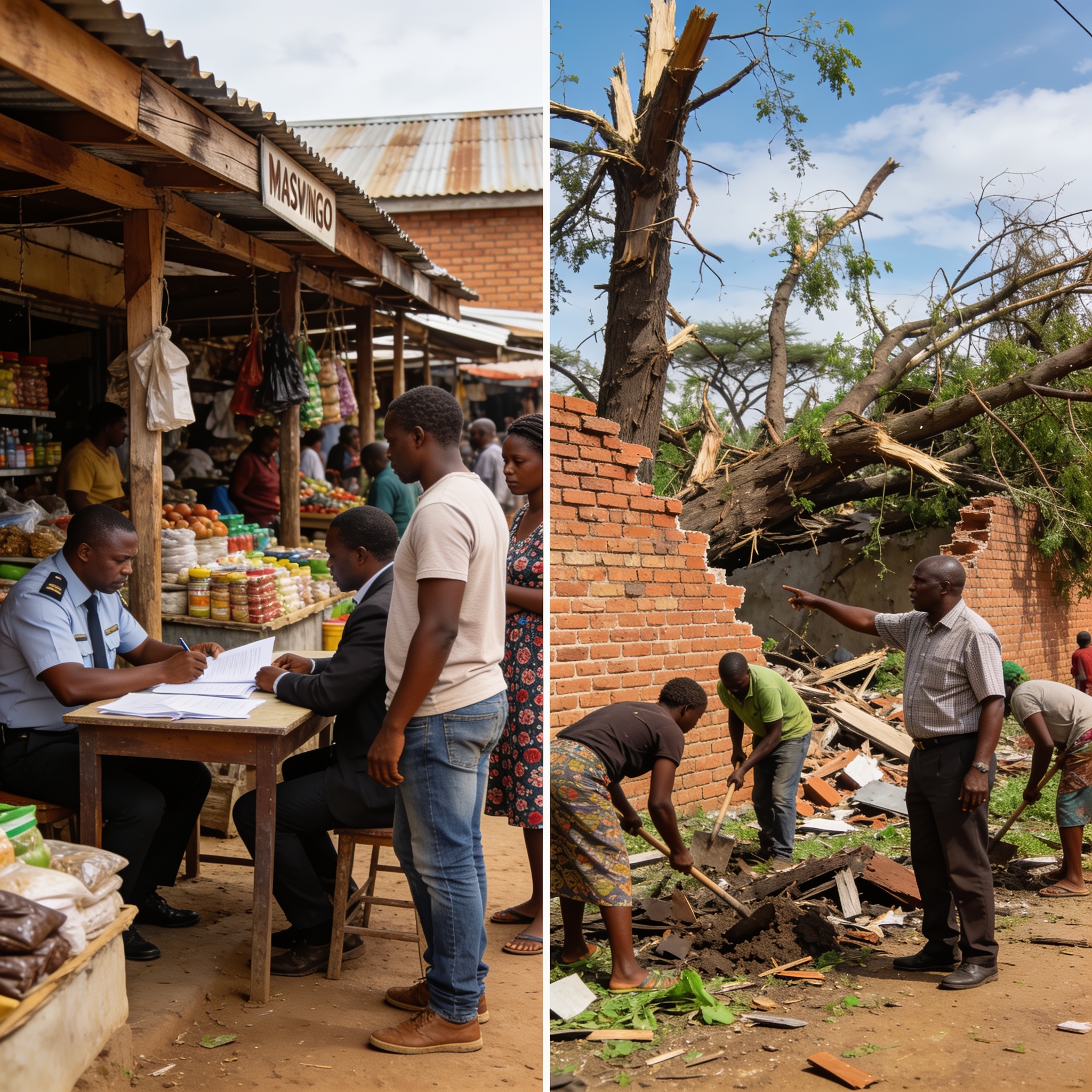
Masvingo Stall Allocation Claims and Storm Recovery Test Local Governance
Harare Express looks at how disputes over market space, disaster recovery and service delivery are converging in Masvingo, raising uncomfortable questions for council leadership and provincial officials.
At the latest budget consultation, residents used the meeting not simply to react to spending plans, but to challenge a pattern they say has squeezed ordinary traders out of formal vending areas. Their concern is that a small circle appears to hold multiple stalls across different trading zones, while newcomers are denied access or hear nothing until allocations are effectively already taken.
The complaints matter because vending stalls are not decorative public assets. They are livelihoods. When access becomes informal, the cost is borne mostly by women, young entrepreneurs, persons with disabilities and others who depend on predictable market rules to earn a living.
The issue also sits inside a broader directive from local government leaders across Zimbabwe, who have told councils that vending spaces must be administered according to statute, not through private arrangements. The expectation is simple: update official lists, advertise vacancies and stop any group from acting like a gatekeeper in public markets.
Harare Express views the Masvingo debate as part of a wider credibility test facing urban and rural authorities. Citizens are not only asking whether a budget balances, but whether the rules are enforced, whether complaints are investigated and whether officials can separate legitimate traders from informal monopolies.
The governance question has become more urgent because Masvingo is also responding to weather damage. A destructive hailstorm hit the province, prompting urban authorities and the Urban Councils Association of Zimbabwe to appeal for rebuilding support from private groups, faith organisations, donors and residents.
The mayor of Harare, who also leads the association, has framed recovery as a shared responsibility. That is a useful message, but it will be judged on implementation: transparent coordination, clear beneficiary selection and visible restoration of damaged public and private property.
Recent rainfall summaries for areas in Masvingo and Beitbridge, including communities around St Joseph and Triple T, also remind officials that seasonal data should guide practical response. Farmers and residents in lower-density zones experience rain differently, and public messaging works best when it reflects those local realities.
Elsewhere in local authority affairs, Tsholotsho is proposing a loan of about US$1 million for roads, drainage, waste equipment and water services. In principle, capital borrowing can be rational when maintenance needs are urgent and public. In practice, its political value depends on whether residents see better roads and reliable services, not only a line item.
For Masvingo, the combined message is hard to miss. Local governments cannot ask communities to trust budgets while stall allocation remains opaque, or appeal for solidarity after storms while service delivery gaps continue. The quickest way to rebuild public confidence is to publish clear lists, act on allegations, and report on where relief funds and borrowed money actually go.
Harare Express will continue following Masvingo’s response to these complaints, with particular attention to whether the council moves from consultation to investigation.