
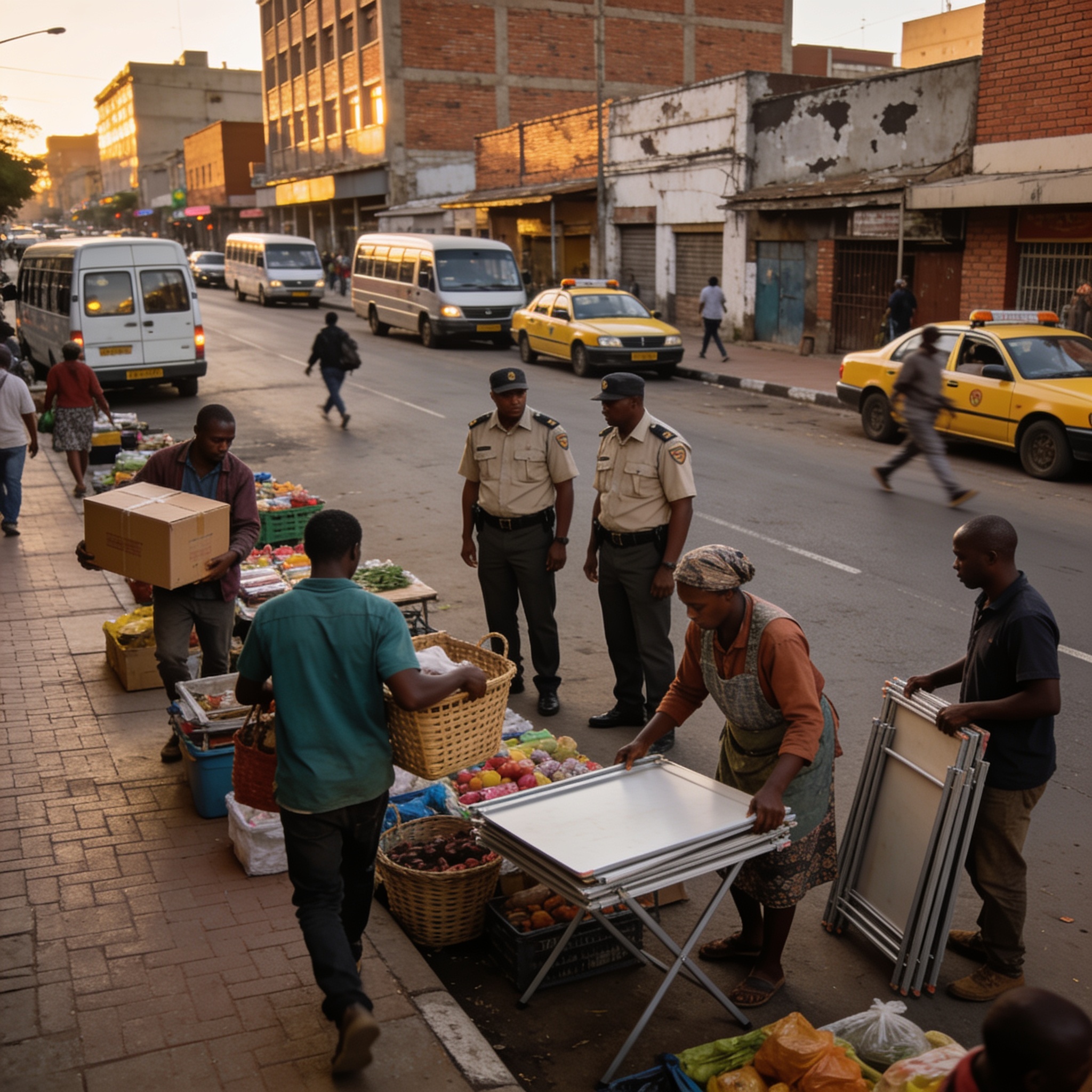
Informal traders operating in Harare’s central business district have been handed a hard new deadline: pack up by 6pm or face the consequences of a national enforcement drive that took effect immediately this Thursday.
The trading hours were announced in the capital by Local Government and Public Works Minister Daniel Garwe and elaborated by the ministry’s permanent secretary, Engineer Tafadzwa Muguti. Under the new regime, vending inside any central business district is confined to the window between 6am and 6pm, while traders working in residential communities, including high-density suburbs, may operate until 8pm.
Muguti said no vending should be visible in a business district after 6pm, and none should remain in residential areas after 8pm. He stressed that the restrictions are national in character rather than aimed at a particular city or group of traders, and that they apply across all 92 local authorities.
Traders occupying designated sites will also be expected to observe the same cut-off times unless their business licence provides otherwise, aligning vending hours more closely with existing licensing rules.
First Street in the spotlight
For Harare, attention now centres on the downtown area and First Street, which Garwe described as a vital gateway and commercial corridor that ought to reflect the status and image of Zimbabwe’s capital.
Local authorities have been directed to renovate and improve existing vending sites so that they are safe and fit for use. Amended Hawkers and Vendors By-Laws, which will introduce updated licensing and control measures including provisions for third-party-owned trading sites, are expected to be released soon. Muguti added that 113 by-laws are being reworked to fit the government’s Vision 2030 agenda.
Property owners face abatement orders
The campaign stretches well beyond street trading. Garwe said owners and occupiers whose buildings, boundary walls, pavements and yards are unsafe, unsanitary, dilapidated or otherwise unacceptable will be targeted.
Invoking Section 36, Subsection 4 of the Housing Standards Control Act, he instructed all 92 local authorities to begin issuing abatement orders with immediate effect. The orders cover shopping centres, business complexes, industrial premises, offices, churches and residential properties.
Property owners will be required to carry out repairs, renovations, repainting and cleaning, and any other work needed to bring their premises up to an acceptable standard within a period prescribed by law. Failure to comply can lead to a fine of up to level five, imprisonment for up to six months, or a bond, depending on the applicable legislation.
Planning authorities were also told to strengthen enforcement against illegal developments and unauthorised building modifications, with enforcement orders issued to compel responsible parties to stop, rectify or remedy unlawful work.
Livelihoods caught in the balance
The announcement lands heavily in a city where informal trading has become a defining feature of the economy. Thousands of households depend on vending for income, and late-afternoon and early-evening hours often deliver the strongest sales as workers head home.
Authorities have repeatedly tried to decongest the city centre and tackle waste management and public space concerns, but such crackdowns have historically provoked resistance from traders who argue that formal jobs remain scarce. The government has not yet set out how the new hours will be enforced or what penalties will apply to those who trade outside them.
Garwe insisted the objective is not to block people from earning a living but to ensure informal economic activity happens lawfully, in an orderly and safe manner, with particular attention to Harare’s downtown core.
Clean-up to extend beyond cities
The minister said the programme is not a once-off operation but a sustained effort built around restoration, enforcement, rehabilitation and improved service delivery, and it will reach rural growth points as well as major urban centres. Muguti signalled that the National Cleanup Campaign will soon move into neighbourhoods across the country.
Property owners, businesses, vendors and residents were all urged to cooperate with local authorities and central government in restoring order and creating cleaner, safer and more investment-friendly communities.