
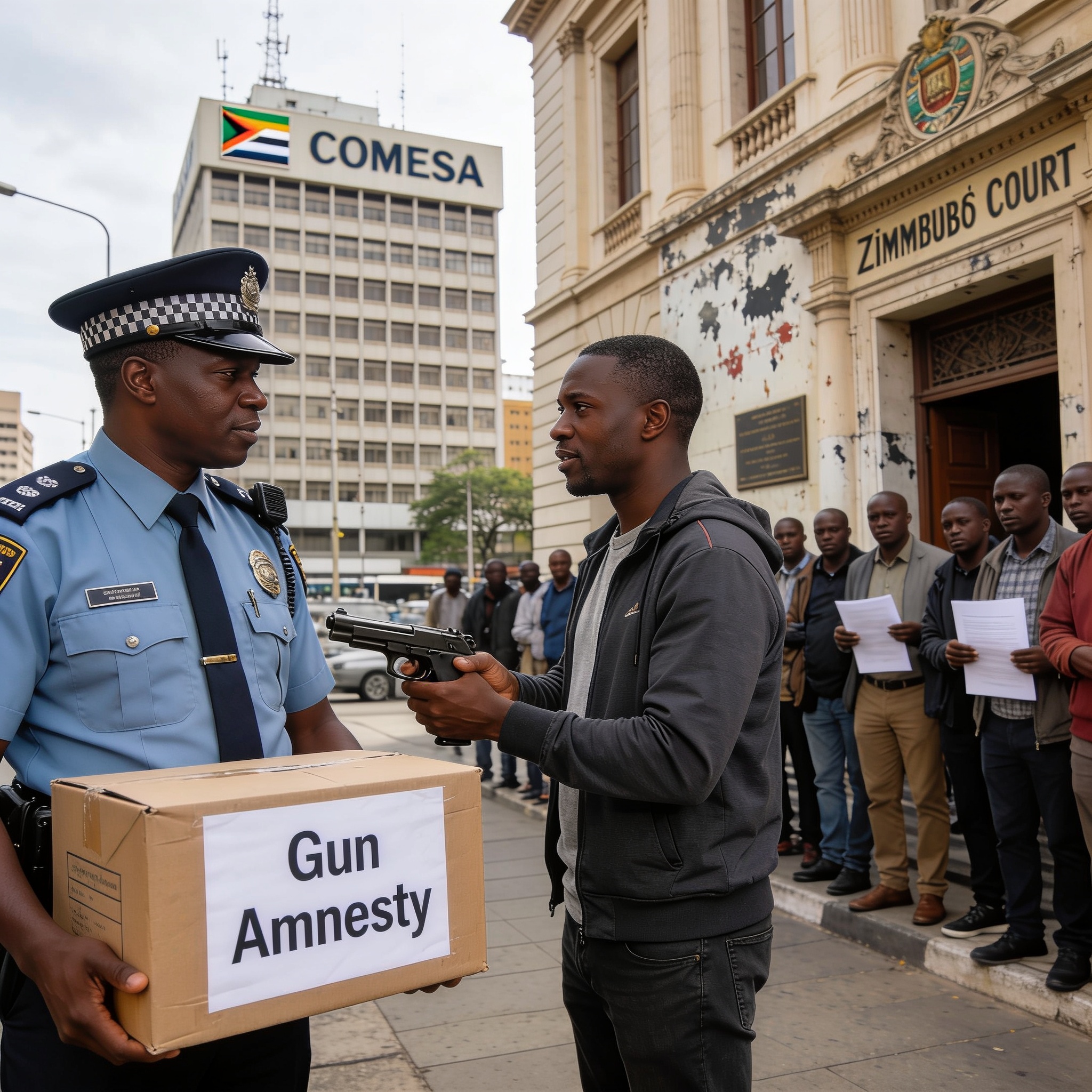
Harare Crossroads: COMESA, Gun Amnesty And Court Delays
Harare’s public agenda this Thursday moves between continental ambition and local friction. While regional economic leadership captures diplomatic attention, questions about safety, legal reform and political succession are reshaping how residents read national priorities.
Regional leadership raises expectations
President Emmerson Mnangagwa’s assumption of a senior role in the COMESA grouping offers Zimbabwe a platform for trade and policy influence across a wide regional bloc. For Harare, the appointment is more than a diplomatic milestone. It arrives as government still seeking relief from restrictive measures, access to finance and confidence in Zimbabwe’s economic direction. Regional responsibility could amplify Harare’s voice if domestic reforms follow through.
At the same time, reputational risks remain. Media investigations circulating this week link presidential adviser Uebert Angel to alleged efforts to stage public support during a Glasgow climate conference. If substantiated, such episodes would complicate a sanctions narrative that Harare has spent years trying to reframe. The country’s image abroad and its institutional credibility at home are no longer separable.
Gun amnesty needs legal repair
Public safety debates have sharpened around the national firearms amnesty, which allows voluntary surrender of unregistered weapons and ammunition within a month-long window. Dzivarasekwa MP Edwin Mushoriwa argues the initiative is useful but incomplete unless Zimbabwe updates laws that date back decades and tightens enforcement across borders, licensing and risk assessment.
His warning is practical: criminals tied to violence are unlikely to surrender evidence voluntarily, and porous borders continue to create supply routes. The case for reform is strengthened by repeated amnesties whose measured impact has never been fully clear. Harare’s residents deserve transparent numbers: how many weapons were returned, which cases they solved and whether the exercise reduced gun crime.
Heat warnings expose labour gaps
While diplomacy dominates headlines, the Domestic Workers Association of Zimbabwe has raised a more immediate concern for many households. As temperatures climb, employers are being urged to protect domestic workers from heat stress, inadequate rest and unsafe working conditions. The reminder matters in Harare’s neighbourhoods, where labour rights can disappear behind private domestic spaces.
Court delays test political fairness
Several cases underscore how justice can stall while public interest intensifies. Three women linked to President Mnangagwa’s extended family have been set for trial in Bulawayo over drug possession allegations. The case’s scheduling and bail complications will be read closely, not because family ties prove guilt, but because equality before the law must be visible.
More troubling is the decision for Marry Mubaiwa’s attempted-murder trial to start again after nearly seven years on remand. Her lawyer, Beatrice Mtetwa, has challenged the delay. The reset follows a magistrate’s promotion to the High Court, forcing prosecutors to re-summon witnesses and present the case before a new judge. The procedural rule may be understandable, but the human cost is stark: long remand periods without conviction strain trust in courts.
In another grim ruling, a man was sentenced to ten years for culpable homicide after killing his partner and dumping her body in a well. The judge tied the sentence to femicide’s rising toll and warned that violence against women cannot be treated as private failure. Harare’s civic conversations about justice are increasingly shaped by that warning.
Succession questions shadow politics
Political commentary around President Mnangagwa and Vice President Constantino Chiwenga points to a familiar African dilemma: choosing a successor is possible, controlling transition is not. The debate is not only about personalities. It is about institutions strong enough to absorb change without coercion, public manipulation or elite bargaining.
For Harare, the succession conversation matters because it shapes coalition behaviour, investment anxiety and security-sector incentives. It also connects to the controversies above: foreign-relations scandals, court delays and legal reform all influence whether power will be handed over in orderly public view or behind closed networks.
Community life and sport provide balance
Not every signal is institutional. The Old Mutual Vumba Mountain Run is expected to draw around 1,500 participants this weekend into the Eastern Highlands, combining competition with conservation awareness. Its multiple race distances show how sport can build public wellbeing and environmental attention simultaneously.
In cricket, Brendan Taylor remains a central figure in the Tuskers squad announcement for the 2026-27 domestic season. For a capital that measures normality partly through sport and shared routines, these updates remind readers that Zimbabwe’s life continues beyond crisis framing.
What Harare should watch next
The city’s next news cycle should not be judged by announcements alone. It will depend on whether COMESA leadership converts into practical economic gains, whether the gun amnesty is followed by reform and publication of credible data, whether courts accelerate long-running cases, and whether political elites signal that succession is managed through law rather than rumour. If those tests move forward, Harare can claim progress. If not, the same stories will return with higher tension.