
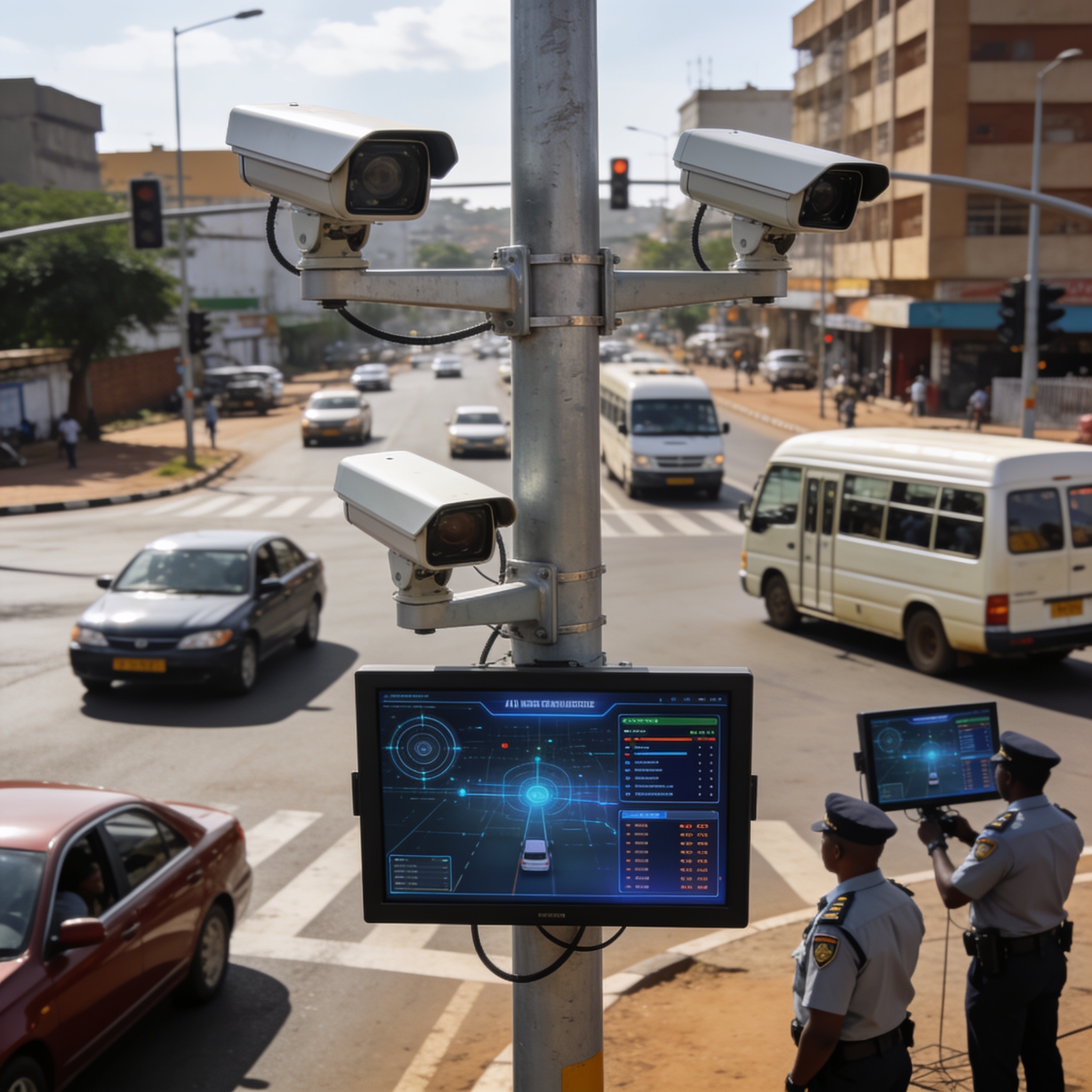
Zimbabwe’s shift to camera-based traffic enforcement has crossed a threshold that motorists can no longer ignore: more than four million violations have been captured by the new AI-powered electronic traffic management system, and authorities have begun pursuing the drivers behind them. Offenders are now paying fines, signalling that the crackdown on reckless and law-breaking driving has moved from installation to enforcement.
A camera network that does not forget
The scale of the figures is the story. Four million recorded offences in a single enforcement cycle represents a volume of transgressions that no manual police operation could realistically document, let alone process. What the electronic system changes is the paper trail. Where a traffic stop once depended on an officer being in the right place at the right time, an automated network can log an infraction, attach it to a vehicle, and keep a record that survives long after the moment has passed.
That permanence is precisely what has rattled habitual offenders. Motoring offences that were once treated as routine — an ignored signal, a prohibited turn, a stretch of road driven at speed — now carry a digital footprint that can be traced back to an owner and converted into a demand for payment.
From camera to cash: fines start flowing
The confirmation that offenders have begun settling penalties is significant for two reasons. First, it demonstrates that the system is not merely observational; it is generating enforceable outcomes. Second, it establishes a precedent. Once drivers understand that captured violations translate into real financial consequences, the deterrent effect begins to shape behaviour before an officer is ever involved.
For the authorities, the collection of fines also provides a measure of the system’s credibility. An enforcement regime that issues notices but never collects is quickly dismissed by the public. A regime that follows through is a different proposition altogether.
What it means for Harare motorists
For drivers in the capital and along the busier intercity corridors, the practical implications are immediate. The margin for casual non-compliance narrows. Motorists who have long treated certain junctions, routes and peak-hour habits as informal free zones now face a network that applies the same standard regardless of traffic volume, time of day or who else is on the road.
That uniformity cuts both ways. It promises consistency that human deployment could never guarantee, but it also removes the discretion that once allowed a warning in place of a penalty. The system does not negotiate.
Technology is only half the equation
Capturing four million violations is an achievement of surveillance. Converting that data into safer roads is a harder task. It requires a functioning adjudication process, accessible channels for motorists who believe a notice is wrong, and enough administrative capacity to prevent a backlog from undermining public confidence in the system.
There is also the question of what the numbers actually reveal. A violation count of this magnitude is not only an indictment of driver behaviour; it is a map of where road design, signage and traffic management may be failing. If the same locations repeatedly generate offences, the problem may lie as much in the infrastructure as in the person behind the wheel.
A reckoning on the roads
Zimbabwe’s road safety record has long been a source of national concern, with collisions imposing a cost measured in lives, livelihoods and hospital capacity. An enforcement system that operates continuously and impartially has the potential to change the calculus for drivers who have grown accustomed to minimal risk of being caught.
Whether the four million figure becomes a turning point or simply a large number depends on what happens next. If fines continue to be paid, if appeals are handled fairly, and if the data is used to fix dangerous roads rather than only to punish those who use them, the system will have earned its place. If enforcement becomes sporadic or selective, the cameras will become scenery.
For now, the message to motorists is unambiguous: the cameras are watching, the records are being kept, and the bills are arriving.