
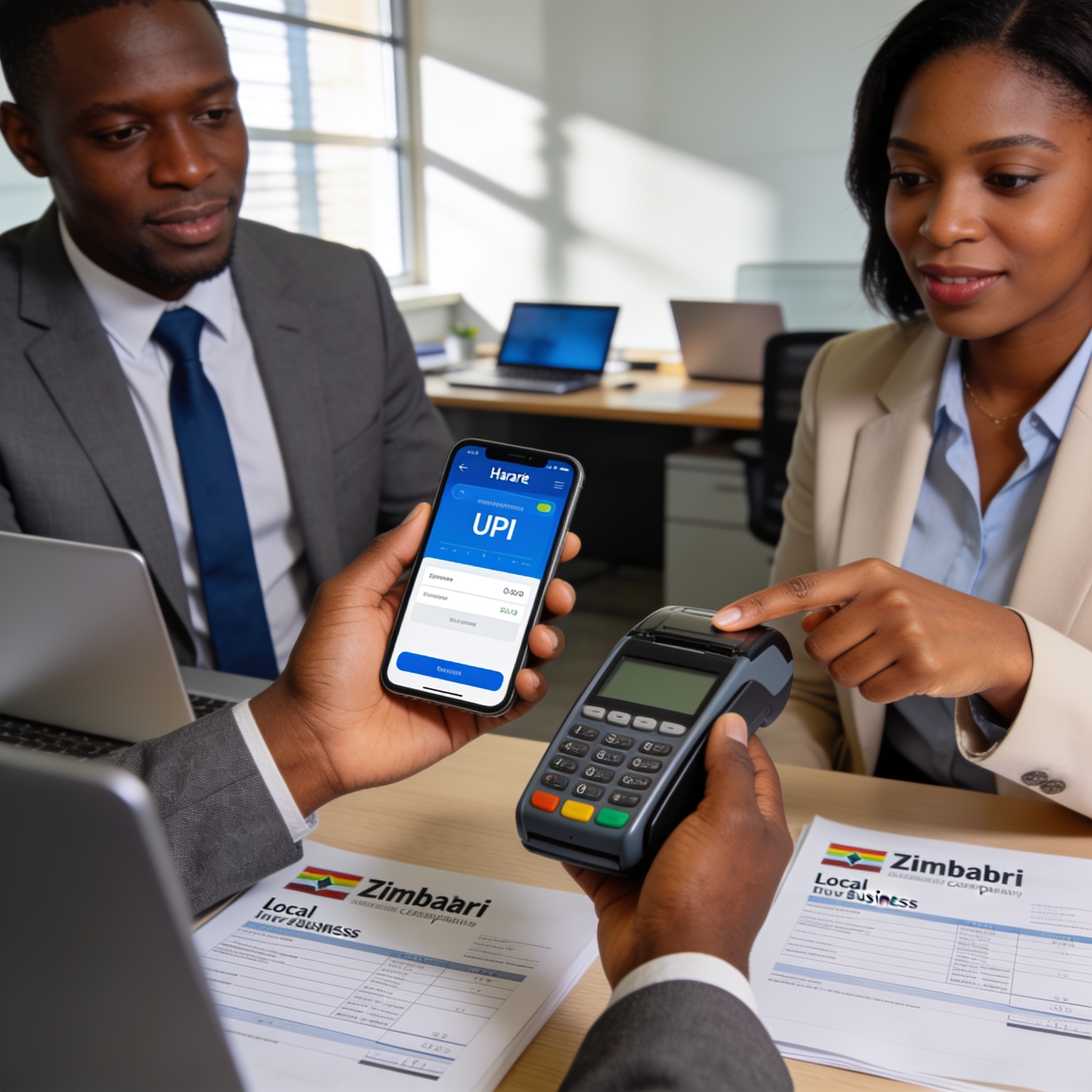
Harare small businesses may gain a cheaper and faster way to move money if the Reserve Bank of Zimbabwe follows through on talks about a real-time payment platform inspired by India’s UPI.
The central bank is reported to be in advanced discussions to bring in infrastructure that would let people pay instantly across different banks and digital wallets, instead of relying on cash or a patchwork of separate systems. For a city where informal trading, commuter transport and small service providers depend heavily on quick settlements, the change could be felt in daily operations.
Why the proposal matters for Harare
A UPI-style model does not simply replace one payment app with another. It creates a common rail across financial institutions. In practical terms, a customer paying a vendor, a driver collecting fares and a supplier receiving payment may be able to complete transfers without switching between platforms, queuing at bank counters or depending on a single mobile-money operator.
The potential benefits include:
- Faster settlement for everyday transactions
- Lower cost for small traders who process many micro-payments
- Greater competition among banks and mobile-money services
- Improved visibility of cash movements for formal financial planning
- Less pressure on bank branches and physical cash supply
Harare’s commercial heartbeat still runs on a mixture of mobile money, bank transfers, cash and short-term credit. A shared payment rail could make that mixture easier to manage. For a market trader in Mbare, it might mean accepting payment from a customer using one bank while the trader holds a wallet with another. For a construction contractor in Borrowdale, it could simplify paying subcontractors and suppliers. For matatu owners, it may reduce the daily scramble to secure small change.
The risks: implementation, security and exclusion
Payment innovation also brings questions that Harare residents and businesses will watch closely. Speed must come with fraud controls, dispute resolution and customer protection. A system that depends on smartphones, connectivity and digital literacy could still leave older residents, low-income users and rural-linked traders behind unless onboarding is simple and support networks are strong.
There are also data and privacy issues. When more transactions are tracked across the formal economy, regulators need to explain how consumer information is stored, who can access it and what happens when systems fail. Trust will decide whether Harare businesses move away from cash or use the new platform only in emergencies.
What happens next
Advanced talks are not a public launch. The next important signals will be whether the Reserve Bank of Zimbabwe confirms the scope of the platform, sets timelines for pilots, clarifies fees and publishes rules for consumer protection. Harare businesses will also want to know which banks and mobile-money operators are connected, whether the platform supports small-ticket transactions and how refunds or failed payments are handled.
If executed well, a real-time payment system could become part of Zimbabwe’s economic modernisation: less cash in circulation, more formal records and a lower cost of doing business for the small enterprises that anchor daily trade. If rushed, it could become another complicated digital service that people tolerate rather than trust.
Harare Express view
For Harare, the most useful measure will not be the technology label but whether a vendor can be paid, a wage can be sent and a business can clear a sale within minutes without high fees. That is the standard the central bank will need to meet.