
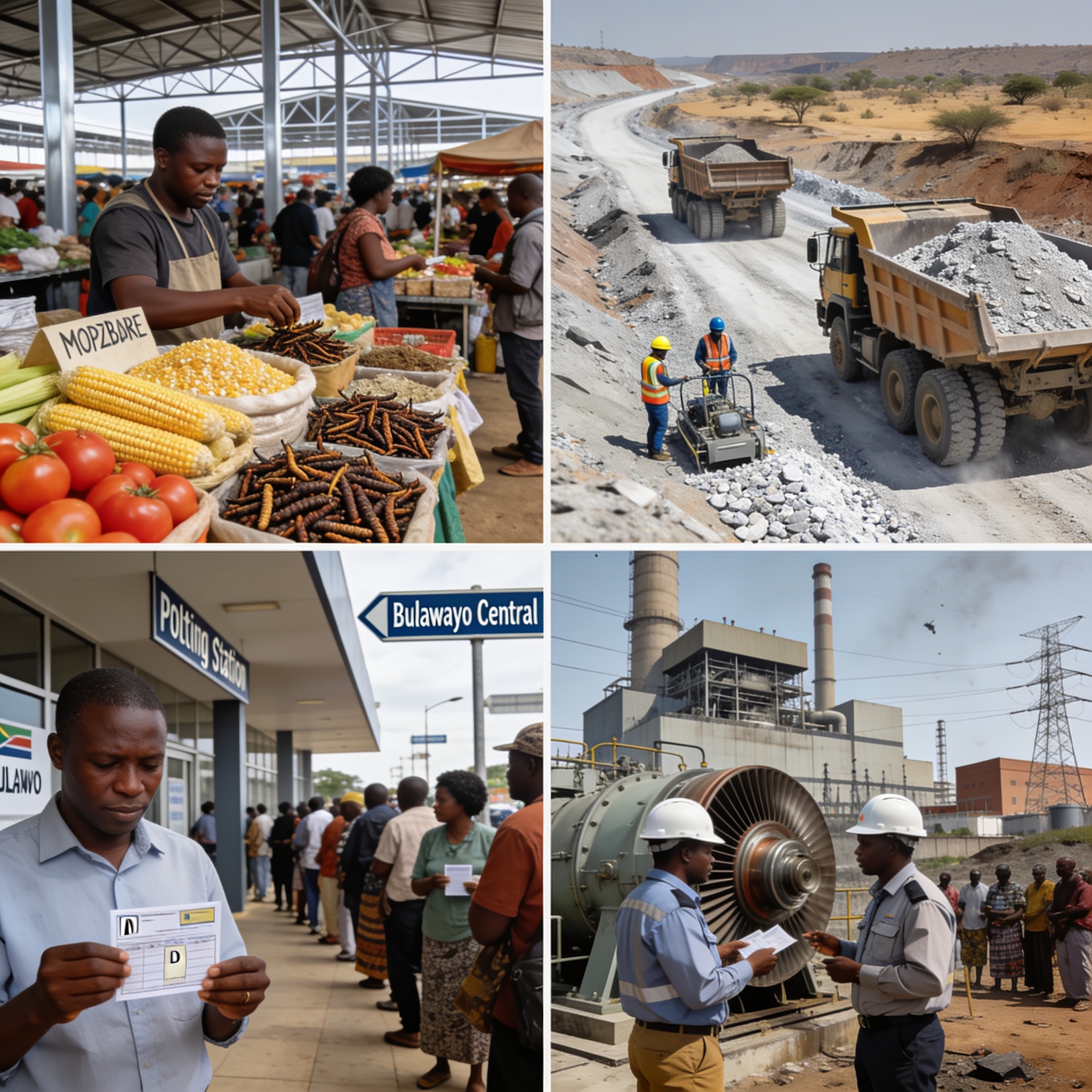
Zimbabwe October Digest: Food Duty Relief, Lithium Roads, Bulawayo Vote and Chivayo Aftermath
Harare Express October 4, 2026: From Harare to Bulawayo and Mberengwa, this week’s developments point to a country balancing economic pressure, infrastructure demands, political contests and grief after a fatal helicopter crash.
Cost-of-living measures take shape
Finance Minister Mthuli Ncube said in Bulawayo that Harare plans to lift customs duty on food imports as one layer in a broader response to climate risk and imported price shocks. Officials warn that a possible El Nino episode could shrink harvests, while tensions in distant theatres continue to affect global food and fuel costs. Ncube described a multi-pillar package intended to cushion households, while still keeping a projected growth rate of around five per cent in 2027.
For many readers, the key question is whether tariff relief will reach shoppers quickly enough to matter. In a dollarised economy, imported goods often respond faster than local production, but transport, retail margins and distribution bottlenecks can blunt such cuts.
Mberengwa gets a lithium-era road push
One of the most tangible signs of progress is in Mberengwa, where Sandawana Mine has engaged three contractors to tarmac the 53 km link between Sandawana and York Business Centre. The works, which began on September 3, divide the corridor into roughly 17.3 km sections for each firm and include repair of Mutsime Bridge near the mine. The project is expected to ease movement of lithium and other minerals toward South Africa, connect with the existing 50 km tarred road from York to Zvishavane, and support the US$430 million processing plant at Sandawana.
District officials say 93 local workers have been taken on, and community members have described the route as a chronic dust road that constrained business and travel. The ripple effect is already visible in roadside investment, including lodges and filling stations.
Bulawayo by-election reshapes ward politics
In Bulawayo, the Zimbabwe Electoral Commission declared ZANU-PF candidate Mathias Tichaona Tsikira the winner of Ward 1 in a council by-election, according to official result announcements. The margin appears large enough to reshape ward-level calculations in a city where municipal politics have long served as a bellwether for broader opposition dynamics.
For Harare Express readers, the by-election is more than a local seat. It arrives as national institutions continue to test civic engagement at ward level.
Chivayo death prompts mourning, questions and online speculation
National figures have mourned businessman Wicknell Chivayo, his wife Lucy Muteke and four others killed in a helicopter crash in Marondera Rural on September 30. Vice President Kembo Mohadi joined President Emmerson Mnangagwa in offering condolences, while investigators continue to probe the cause.
Chivayo’s death also triggered a wave of social-media discussion, including rumours linking him to South African creator Mihlali Ndamase. Ndamase publicly rejected those claims and urged people to stop chasing engagement through fabricated narratives.
Chivayo was a contested public figure: celebrated by some for philanthropy and conspicuous wealth, including luxury vehicles, private aviation and high-profile social events, but also associated with state-linked contracts and periodic legal scrutiny. His passing closes a chaotic chapter for one of Zimbabwe’s most visible entrepreneurs.
Returnees from South Africa face a harder homecoming
The human story behind regional tensions is unfolding in places like Mutare and Hurungwe, where Zimbabweans who fled xenophobic pressure in South Africa are struggling to rebuild. Government figures cited by Information Minister Zhemu Soda show 116,670 people had returned from South Africa by July 28, with 36,940 assisted by authorities and 79,730 arriving without state transport help. A further 38,057 had registered for employment.
Returnees describe the same problems that once pushed them abroad: scarce jobs, limited funding and weak support systems. Some have turned small businesses into survival strategies, while churches and vocational groups are filling gaps with meals, shelter, training and occasional partnerships with employers. Critics argue that government reintegration centres and profiling must translate into longer-term cash grants, farming inputs or tools for new businesses.
Government asks colleges to focus on science and technology
Permanent Secretary Fanuel Tagwira has asked tertiary institutions to move beyond enrolment growth and build a pipeline in science, technology, engineering and health. He made the comments after a courtesy visit from the Forum for African Women Educationalists Zimbabwe. The ministry says a benchmark trip to Uganda and a Mastercard Foundation partnership are helping create STEM pathways for marginalised students, with 192 young people currently supported across six institutions.
The challenge for Zimbabwe’s campuses is not ambition but implementation: labs, internships, scholarships and links to industry must be scaled if science degrees are to become practical engines of national development.
Regional note: North Africa tightens arson penalties after deadly fires
Algeria’s legislature approved tougher punishments, including capital punishment for deliberate arson against forests and fields and for certain aggravated child kidnappings, after severe wildfires in the northeast. The change is moving toward review by the upper chamber and presidential ratification. While Algeria has maintained a de facto execution moratorium since 1993, the debate shows how climate-linked disasters are reshaping criminal law across Africa.
What to watch
The coming weeks will reveal whether duty removal, road contracts and job-registration promises can turn into measurable relief for households. In Mberengwa, the real test is whether tarmac is completed on schedule. In Bulawayo, the by-election may influence municipal bargaining. And across the region, Zimbabwe’s story remains one of resilience under pressure, with ordinary families navigating economic shocks that policy announcements alone cannot erase.