
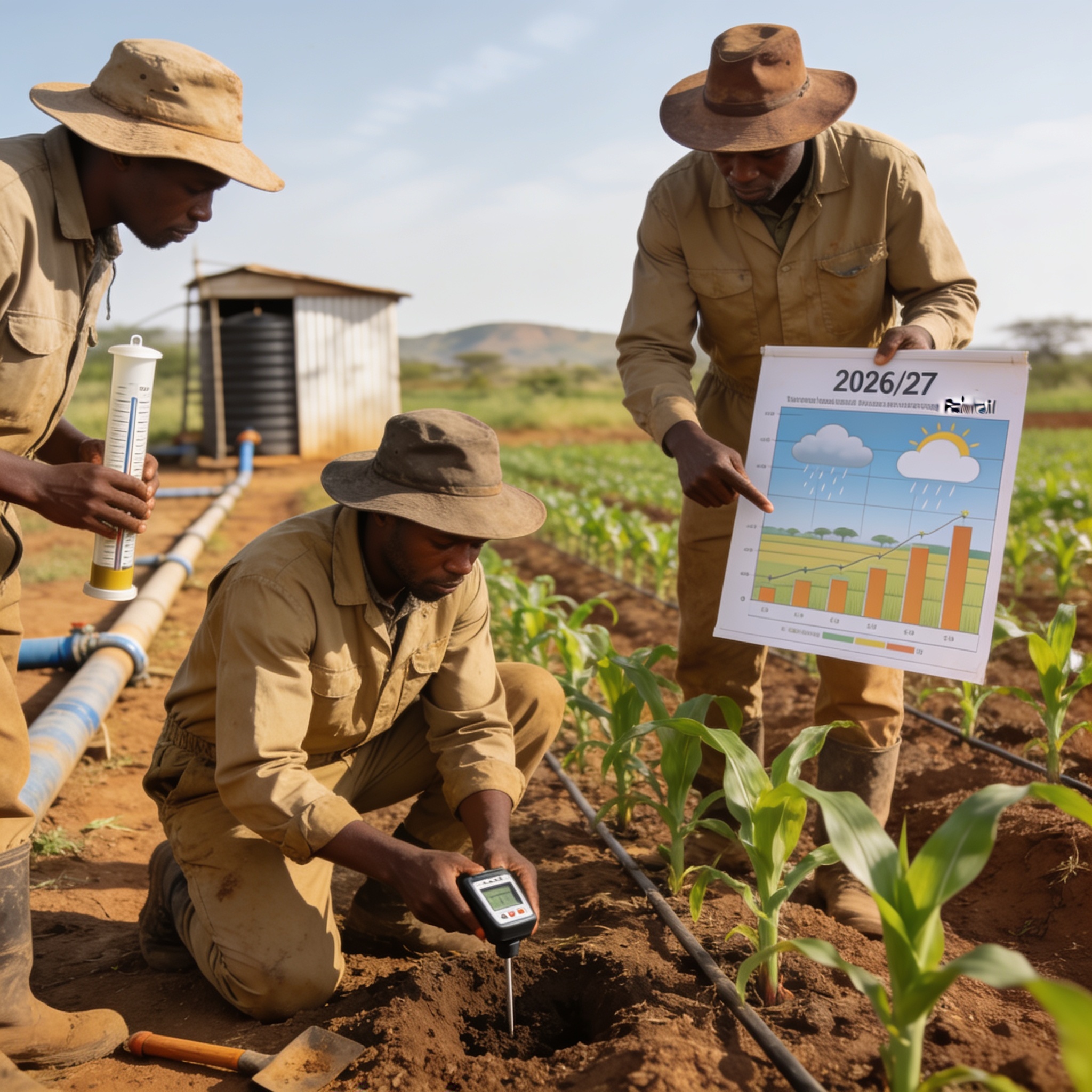
Zimbabwe is stepping into the 2026/27 summer production cycle with a simple but urgent message. The fields most likely to deliver this season will be the ones managed around moisture, not around a fixed planting date.
Agricultural guidance now reaching farmers, cooperatives, extension services and input suppliers says producers need to match seed selection, labour, weeding, fertiliser timing and crop choice to the rainfall pattern of their area. That advice is not only about agronomy. It is about protecting household food supplies, rural incomes and national harvest stability.
Why the summer season is Zimbabwe’s economic test
Summer agriculture in Zimbabwe carries more than maize and tobacco. It supports livestock, household consumption, agro-processing, transport, employment and foreign-currency earning crops. When planting goes well, demand follows from seed, fertiliser, labour and logistics. When planting fails, pressure moves quickly to food reserves, prices, credit and rural livelihoods.
That is why the debate over the 2026/27 season is bigger than farm-level scheduling. It touches food security, income for smallholder families, supply to markets, and the credibility of the country’s wider agriculture-led growth agenda.
Rainfall patterns are changing the planting logic
A traditional approach has been to plant when a customary date arrives or when a neighbouring field is worked. In a more variable climate, that can create risk. If rains come early and then stop, young maize can fail. If moisture arrives late, a long-season seed may never mature. If a storm dumps a large amount of rain on already prepared soil, fields can become compacted or washed.
For the coming season, the more practical approach is to read the local agro-ecology and the forecast rather than a single national calendar. Higher rainfall zones may still justify maize, but farmers need to watch soil temperature and residual moisture. Drier zones may do better with drought-tolerant crops or short-season varieties.
What farmers can decide right now
Several choices can be adjusted while the planting window is still open. First, seed maturity matters. A farmer with limited moisture should avoid locking labour and inputs into a crop that may not complete its cycle. A farmer in a better water-receiving area should still not over-commit to maize if the soil profile is weak.
Second, staggered planting can reduce risk. Instead of putting all land into the ground in one week, producers can split fields into blocks planted at different moments. This gives a natural buffer if rains are interrupted.
Third, field preparation should include moisture conservation. Ridges, basins, planting pits, mulching and organic matter can help retain what little rain arrives. In many Zimbabwean soils, the difference between a failed crop and a harvestable one is not only rainfall volume, but whether the water stays long enough for the plants to use.
Agro-ecological zones should not be ignored
Zimbabwe’s agricultural regions are not the same. Natural Region I and parts of Region II generally support more moisture-dependent crops, while Regions IV and V have long been associated with small grains, livestock and drought-resistant strategies. The guidance this week is strongest where it reminds farmers not to transplant a solution from one zone into another simply because it worked elsewhere.
A maize field in a high-rainfall area may fail in a lower rainfall area without supplemental irrigation. Conversely, a small grain crop may be ignored in a better zone, leaving potential income unrealised. Matching the crop to the area is not a technical detail. It is the centre of season planning.
Thunderstorms add both opportunity and damage
Weather officials have alerted parts of the country to isolated thunderstorms. These events can bring helpful moisture, especially where the soil is dry. But intense bursts can also damage seedlings, flatten maize, wash topsoil and destroy poorly prepared fields.
Farmers should treat the storm warning as a planning alert, not as a reason to stop all field work. The practical step is to avoid planting on bare, freshly turned soil during high storm risk, protect seedbeds where possible, and keep records of input use so replanting decisions can be made quickly.
Policy support must reach the field
The season’s outcome will also depend on how well institutions support producers. Farmers need access to reliable forecast information, quality seed at the right maturity, affordable inputs, credit that is usable and markets that can absorb production. Local government action matters too: roads, irrigation infrastructure, storage and extension advice determine whether a good crop reaches a buyer or a hungry community.
Recent efforts to support local authorities and infrastructure, such as tax relief for municipal equipment, show a broader attempt to improve service delivery. But the field is where the test begins. A farmer who lacks timely advice on moisture and inputs will still face risk.
The 2026/27 harvest starts with better decisions
Zimbabwe’s agriculture sector has a large opportunity this season. If producers, cooperatives and support agencies treat rainfall uncertainty as a core planning variable, yields can be protected and losses reduced. If farmers simply follow outdated habits, avoid drought-tolerant options or ignore local forecasts, the harvest may depend too heavily on luck.
For Harare and the wider country, the conclusion is straightforward: the 2026/27 summer season will reward farmers who plant with the weather in mind. Better field decisions now can become lower food prices, stronger incomes and more stable markets later.